U.S. Businesses: Stop Review Gating and Audit Your Review Flow

Review gating is the practice of screening customers before inviting them to leave a public review, filtering out anyone likely to leave a negative one. It breaches Google’s platform policies outright, and since October 2024 it sits inside the Federal Trade Commission’s Consumer Reviews and Testimonials Rule too. The fix isn’t complicated: stop filtering who gets asked, and route dissatisfied customers to a private feedback channel instead.
TL;DR:
- Review gating filters dissatisfied customers from leaving public reviews, violating both platform policies and the FTC’s new rules for deceptive practices.
- Most gating occurs subtly through pre-rating questions or staff decisions, misleading consumers with a biased view of the business’s reputation.
- Platforms actively penalize gated reviews by removing them, restricting visibility, or suspending profiles without the need for legal action.
- The FTC move in October 2024 means businesses could face multiple violations and penalties for systematically suppressing negative feedback.
- Auditing review flows and adopting an equal, no-filter approach with optional private feedback is the only compliant method to protect reputation and avoid legal risks.
Table of Contents
- What review gating actually looks like
- What Google and the major platforms say about it
- The legal risk: the FTC’s rule and real penalties
- How to audit your review funnel for gating
- Compliant alternatives that still protect your reputation
- How Blindspot audits and rebuilds review flows
- Editorial take: why the compliance conversation gets skipped
- Get your review funnel audited properly
- Where to check the rules yourself
- Sources
- FAQ
What review gating actually looks like
Gating rarely announces itself. It hides inside ordinary-looking feedback flows, which is exactly why so many businesses stumble into it without meaning to.
The common patterns:
- A pre-rating question (“How was your experience?”) that routes anyone below four stars to a private form and everyone else to Google or Trustpilot.
- Review request emails sent only to customers flagged as “promoters” in a satisfaction survey, with detractors quietly excluded from the campaign.
- Staff manually deciding, job by job, whether a customer “deserves” a review link.
- Kiosk or QR-code setups where a smiley face sends you to a public review page and a frown sends you to a comment box nobody else ever sees.
The mechanics matter because they mislead the people reading the reviews, not just the platform hosting them. A five-star average built by filtering out unhappy customers is not a true picture of the business, and it hands potential customers a biased sample to make decisions on. Compare that with a routed flow: everyone gets the same public review link, and a private feedback option sits alongside it as a genuine alternative, not a diversion for the unhappy ones.
What Google and the major platforms say about it
Google’s guidance on prohibited and restricted content bans policies or workflows that intentionally exclude negative reviewers from the invitation process, treating it as review manipulation rather than a grey area. BrightLocal’s breakdown of review gating confirms the same principle applies across most major review platforms, not just Google.
The consequences are operational, not theoretical. Platforms have removed reviews collected through gated campaigns, flagged Google Business Profiles for suspicious review patterns, restricted a listing’s visibility in local search, and in repeat or severe cases suspended a profile outright. None of these outcomes require a court case. A platform’s trust and safety team can act on its own judgement, often triggered by an algorithm spotting an unnatural review velocity or a suspiciously lopsided sentiment split.
Platforms increasingly treat gating alongside other forms of review manipulation, such as incentivised five-star swaps or fake reviews bought in bulk. Reuters reported that Google has pursued legal action against businesses selling fake reviews, a sign that platforms are willing to escalate beyond simple removals when manipulation is systematic. Gating sits on the same spectrum, even though it’s subtler than outright fabrication.
The legal risk: the FTC’s rule and real penalties
The FTC’s Consumer Reviews and Testimonials Rule (16 CFR Part 465) took effect in October 2024, and it prohibits businesses from suppressing negative reviews through deceptive practices, gating included. This moved review manipulation from a purely reputational risk into a federal compliance matter with civil penalties attached.
The rule’s logic is blunt: each suppressed review can be treated as a separate violation, not one blanket infringement. A business that gated a thousand unhappy customers over a year hasn’t committed one offence. It’s exposed itself a thousand times over, at least in principle, with civil penalties adjusted annually and enforcement now genuinely underway rather than theoretical. LegalClarity’s analysis of the rule sets out how systematic suppression can trigger significant penalties under consumer-protection law, separate from any punishment a platform hands out.
That’s the part most business owners miss: platform penalties and regulatory penalties don’t cancel each other out, and they don’t require the same evidence threshold. You can lose your Google Business Profile visibility and still face a federal inquiry over the same conduct. Treating “the platform hasn’t noticed yet” as safety is a mistake.
How to audit your review funnel for gating
Most businesses that gate reviews didn’t design the practice deliberately. It arrived bundled inside a reputation management tool, a survey template, or a well-meaning staff habit. Auditing means walking your own flow the way a regulator or a suspicious customer would.
- Map the entire flow end to end. Every step from “thank you for your purchase” to the final review link, including any branching logic.
- Test it as both a low and high rater. Submit a deliberately negative response and a positive one through the same channel and compare where each one leads.
- Check campaign targeting. Pull the segment list behind any review request email and confirm it includes every customer, not just those flagged as satisfied.
- Review your templates. Read the actual wording sent to customers, checking for language that nudges only happy respondents towards a public link.
Pro Tip: Keep screenshots and timestamps of every test you run, alongside the routing logic your survey tool used at the time. If a platform or regulator ever asks how your review process worked, “we can show you exactly what every customer saw” is a far stronger position than “we believe it was fair.”
If you use a third-party reputation platform, ask it three direct questions: does every customer see the same public review options regardless of their answers, does the platform log routing decisions for audit purposes, and can it produce evidence that private feedback was optional rather than a diversion. A vendor that hesitates on any of those answers is a liability, not just a workflow.
Compliant alternatives that still protect your reputation
The compliant version of this process is called review routing, and the difference from gating comes down to one rule: every customer gets the same public review invitation, regardless of how they answer any prior question. TrueReview’s explanation of routing versus gating makes the distinction clear: private feedback can exist as an optional side door, but it can never replace the public door for unhappy customers.
Good routing design follows a few consistent patterns:
- Present the public review link to everyone, at the same point in the journey, with identical wording.
- Offer a private feedback form as an additional option, framed as “want to tell us more privately?” rather than the only path for low scorers.
- Space requests sensibly, once per transaction or service visit, rather than repeatedly chasing the same customer.
- If you offer an incentive for leaving any review, disclose it clearly and offer it regardless of the review’s sentiment, never conditional on a positive rating.
| Approach | What happens | Compliance status |
|---|---|---|
| Gating | Only satisfied customers get the public review link | Breaches platform policy and FTC rule |
| Routing | Everyone gets the public link; private feedback is optional | Compliant |
| Universal ask, no filter | Every customer asked the same way, no pre-screening | Compliant and simplest to implement |
The business case for this isn’t just legal cover; understanding the Vorteile von Kundenfeedback can help businesses appreciate why authenticity matters in feedback. BrightLocal’s research shows that star ratings and the substance of review content are among the strongest factors shaping a customer’s decision to buy, which means an authentic spread of reviews, including the odd critical one answered well in public, tends to build more trust than a suspiciously flawless profile.
How Blindspot audits and rebuilds review flows
Fixing a gated funnel is usually a mapping exercise before it’s anything else. Blindspot’s approach starts by tracing a client’s existing review request flow end to end, then submitting test responses at both ends of the satisfaction scale to see where each one actually lands.
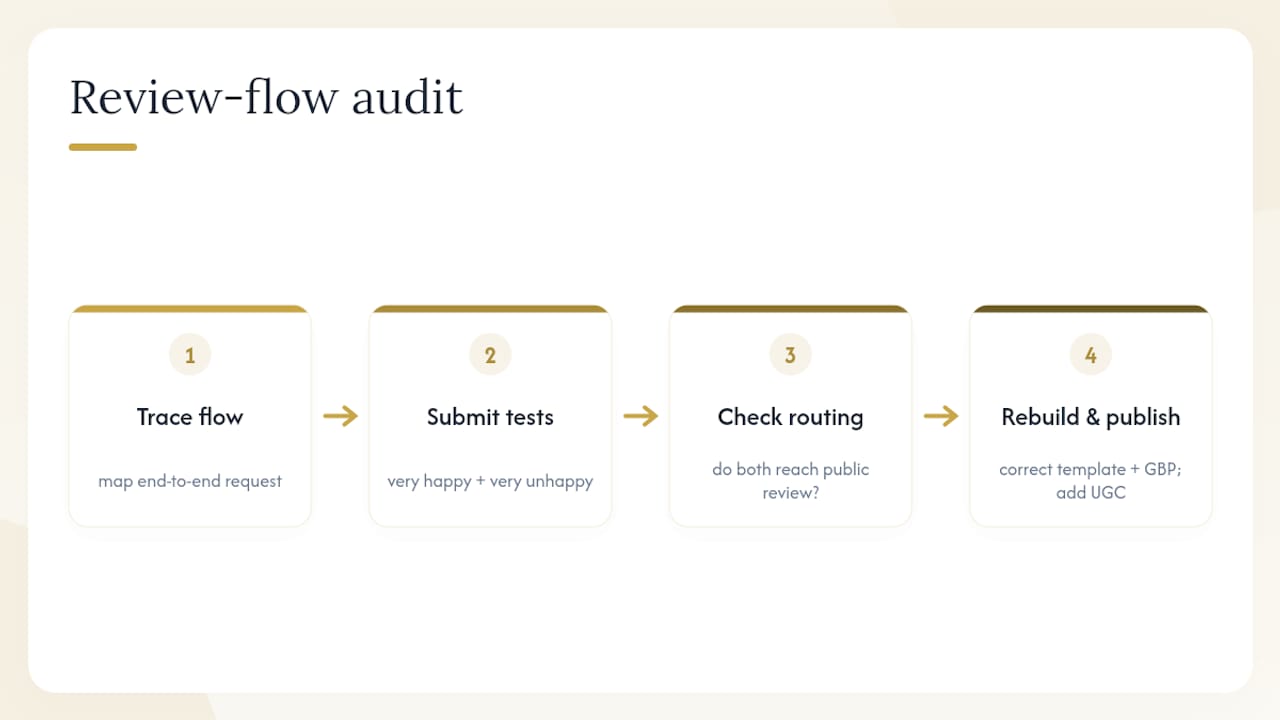
Where a flow needs rebuilding, the work usually pairs a corrected review request template with Google Business Profile optimisation, so the public review channel is both compliant and genuinely visible in local search. For businesses that want reviews and testimonials that don’t rely on gated flows at all, user-generated content built from real customer stories can sit alongside review requests as an owned, controllable asset. Clients who’ve had their review process corrected this way typically see steadier review growth and fewer flagged-profile scares, without the compliance exposure gating carries.
Editorial take: why the compliance conversation gets skipped
Most advice on this subject treats review gating as a marketing tactic gone slightly wrong, a growth hack that needs a light polish. That framing undersells the problem. Since the FTC’s rule took effect, this is a compliance issue with the same seriousness as mishandling customer data, and it deserves to be treated with the same discipline, not bolted onto a marketing checklist as an afterthought.
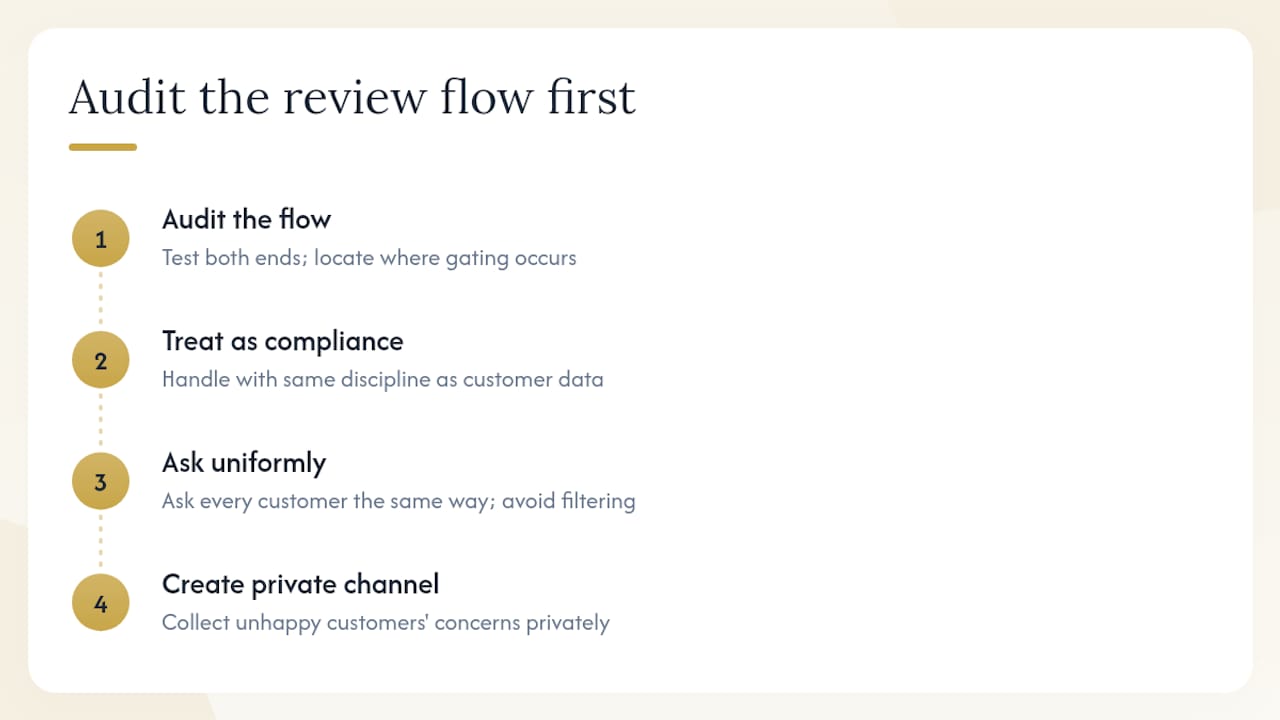
The conventional advice, “just ask happy customers more often”, also misses the point entirely. The fix isn’t asking happy customers more. It’s asking every customer the same way, then designing a genuinely useful private channel for the ones who aren’t happy, so their concerns get seen without contaminating your public profile with a filtered sample.
If you prioritise one thing from this, make it the audit, not the fix. You can’t correct a flow you haven’t actually tested from both ends. Most businesses discover the gating happened somewhere in a tool they didn’t build themselves, a survey template, a CRM automation, a well-meaning script a staff member wrote years ago. Find that first.
— Harry
Get your review funnel audited properly
An alternative to guessing whether your review process is compliant. Rather than leaving your Google Business Profile exposed to a policy strike or a regulatory question you can’t answer, we map your existing review flow, test it from both a happy and unhappy customer’s perspective, and hand you a clear list of fixes alongside broader Google Business Profile and local SEO work.
A first step usually looks like a short audit: we walk your current review request process, flag anything that resembles gating, and recommend a routing structure that keeps every public ask universal. For businesses wanting to reduce reliance on review requests altogether, our social media and content teams can build genuine customer stories that carry weight without touching a review platform at all. Get in touch with Blindspot to book an audit and see where your current flow stands.
Where to check the rules yourself
Read the FTC’s own explanation of the Consumer Reviews and Testimonials Rule for the legal detail, Google’s policy pages for platform-specific rules, and BrightLocal’s review gating guide for a practical industry explainer.
Sources
- What Is Review Gating & What Are the Risks? (BrightLocal)
- What Is Review Gating? (TrueReview)
- Is Review Gating Illegal Under Consumer Protection Law? (LegalClarity)
FAQ
What does review gating mean?
Review gating means filtering customers before asking for a review, so only those likely to leave a positive one receive the public request, a practice that platforms and regulators now treat as manipulation.
What is review gating on Google reviews?
On Google specifically, it means steering satisfied customers towards a Google Business Profile review link while diverting unhappy ones to a private form, a pattern that breaches Google’s policy on prohibited content and can trigger review removal or profile action.
What is a review gate?
A review gate is any screening step, a pre-rating question, a satisfaction survey, or a staff decision, placed before the actual review request that determines who gets invited to leave a public review and who gets quietly filtered out.
What do genuine five-star reviews look like?
A genuine five-star review usually names something specific: the technician’s name, the exact problem solved, or a detail about timing or communication, rather than generic praise, which is one reason authentic profiles tend to show a natural mix of ratings rather than a uniform wall of perfect scores.
Is review gating actually illegal, or just against platform rules?
Both. It breaches Google’s and other platforms’ policies, which can get a profile penalised, and since October 2024 it can also breach the FTC’s Consumer Reviews and Testimonials Rule, which carries civil penalties.


