3 SEO Moves That Drive Leads for U.S. Home Builders
Claim your Google Business Profile, publish real project pages with photos and details, and start collecting reviews on every completed job. Those three moves drive most of the search-based leads available to a home builder right now. Everything else in SEO for builders (schema, backlinks, keyword research) matters, but it compounds on top of that foundation. Do this first, this week, before touching anything else.
TL;DR:
- Claim your Google Business Profile fully, add detailed project photos weekly, and respond to reviews promptly to maximize local search visibility.
- Build dedicated service-area pages with local details and budget ranges to target qualified leads and improve organic rankings within 60 to 90 days.
- Ensure your website features real project pages with photos, scope, timeline, and pricing, and implement schema markup for better search engine understanding.
- Fix common SEO issues like duplicate templated pages, oversized images, and messy metadata to boost site crawlability and user experience.
- Track leads through call and form conversion data to measure true ROI, focusing on qualified inquiries and project value rather than vanity metrics.
Table of Contents
- Why SEO Matters for Home Builders
- Common SEO Issues Builders Face and Quick Fixes
- Local SEO and Google Business Profile: What to Prioritize First
- Website Structure and Project Pages That Rank and Convert
- Keyword Research and Content Priorities for Builders
- Timelines, KPIs, and What ROI Actually Looks Like
- DIY vs Hiring an Agency: What Blindspot Sees Work
- A Builder’s Checklist: What to Do This Week
- Blindspot’s Builder SEO Services
- Sources
Why SEO Matters for Home Builders
Homeowners research online before they call anyone. Statista’s data on home search behavior shows internet search is a dominant habit across nearly every age group shopping for a home or a builder, not just younger buyers. If your business does not show up in that research phase, you are not in the running. It is that simple.
Two different search behaviors matter here, and builders often conflate them. The Google Business Profile / local pack (the map results with the three pin-drop listings) captures people ready to compare builders in their area right now. Organic website results capture people still researching, reading about project types, timelines, or costs. Both feed your pipeline, but they need different assets: GBP needs reviews and consistent activity, organic search needs actual content on your site.
Here’s the part builders underestimate: your website’s structure decides how well either channel converts once someone lands there. A site built around real project pages, with photos, scope, and pricing ranges, answers the three questions every homeowner has before they’ll pick up the phone: what did you build, how long did it take, what did it cost. Scale Growth Digital’s construction marketing research found that portfolio-first sites convert at meaningfully higher rates than generic “About Us and Services” templates, because they remove the guesswork from a high-stakes purchase decision.
Quick math on why this matters: if your GBP and website combined generate even a handful of extra qualified calls a month, and your average project value runs into the tens of thousands, the math on SEO’s return works itself out fast compared to most paid channels.
Common SEO Issues Builders Face and Quick Fixes
Most builder websites share the same handful of problems, and none of them require a full rebuild to fix.
Duplicate templated pages. Many builders spin up a “service area” page for every town they cover, then paste the same paragraph with the city name swapped. Google sees this as thin, duplicate content and often won’t rank any of them. Rewrite each page around what’s actually different: local permit quirks, neighborhood housing styles, a finished project in that town.
Oversized, unoptimized images. A gallery of 20 uncompressed photos from a job site can quietly add several seconds to page load. Convert to WebP or AVIF formats, resize images to their actual display dimensions, and enable lazy loading so only visible photos load immediately.
Missing schema and messy metadata. Search engines need structured signals to understand what your pages represent. Google’s own guidance on SEO fundamentals is direct about this: crawlability and clear site structure aren’t optional extras, they’re the baseline for being discoverable at all.
Quick fix checklist:
- Add LocalBusiness schema to your homepage and contact page
- Write unique title tags and meta descriptions for every service and location page
- Check Google Search Console for crawl errors and fix broken internal links
- Make your phone number a tap-to-call link on every page, not just the contact page
- Test your site on an actual phone, not just a desktop browser
Pro Tip: Call your own business number from your phone while standing on your website. If it takes more than one tap to find and dial, you’re losing calls you never hear about.
Local SEO and Google Business Profile: What to Prioritize First
Local search is where most builders win or lose fastest, because the local pack rewards completeness and activity more than raw domain authority.
- Claim and fully build out your GBP. Choose the most specific primary category available (general contractor, home builder, remodeler), add every relevant secondary category, and list your actual service area rather than relying on a single pinned address.
- Upload real project photos weekly. Before-and-after shots, crew on-site, finished exteriors. Profiles with recent photo activity consistently outperform static, unchanged listings.
- Post updates on a regular cadence. A short post about a completed project or seasonal service reminder keeps your profile signaling activity to Google.
- Respond to every review within a few days. Response speed and recency both feed into how Google and homeowners judge your listing.
- Match your business name, address, and phone number exactly across every directory. Houzz, the Better Business Bureau, and local trade directories all need identical NAP details, since mismatches confuse both search engines and homeowners cross-checking your legitimacy.
Review generation deserves its own process, not an afterthought. Ask at the moment of highest satisfaction, which is typically walkthrough or final punch-list completion, not weeks later when the request feels random. Ask for specifics: the project type, the neighborhood, what stood out. Generic five-star reviews help less than detailed ones mentioning “kitchen remodel in Westlake” or “custom home build, finished on schedule,” because that language also feeds your keyword relevance.
If you build across a wide radius or multiple towns, build dedicated service-area pages rather than trying to make one page serve every location. A subdivision-level page targeting a specific neighborhood competes against far less content than a broad city-wide term, and RankPill’s analysis of builder SEO found these hyperlocal pages can start ranking within 60 to 90 days when built with genuine local detail instead of copy-paste text.
Website Structure and Project Pages That Rank and Convert
Your homepage has one job: make the value proposition and the phone number impossible to miss. That means a clear one-line statement of what you build and where, a click-to-call button above the fold, a trust bar (years in business, license number, associations), and three to five featured projects with photos, not stock imagery.
Every completed project deserves its own page, built to a consistent template:
- A gallery of real photos, not renderings
- Project scope in plain language (square footage, room count, key features)
- Timeline (how long the build took)
- Budget range, not an exact figure
- Location or neighborhood
- A short client testimonial where you have one
That budget range matters more than it looks. Including it pre-qualifies leads before they call, filtering out homeowners whose expectations don’t match your pricing tier and raising the percentage of inquiries worth your time.
On the technical side, implement LocalBusiness schema sitewide, Project or WorkExample schema on individual portfolio pages, and AggregateRating schema where you have enough reviews to support it. Bravery Technology’s construction marketing research notes that a majority of construction site visitors now browse on mobile, which makes page speed a conversion issue, not just a technical one. Target a load time under three seconds on mobile, use WebP or AVIF image formats, size images to their actual display dimensions, and lazy-load anything below the fold.
Keyword Research and Content Priorities for Builders
Skip broad, competitive terms and build around three buckets in this order:
- Service plus location, bottom-funnel pages. Think “custom home builder in [town]” or “kitchen remodel contractor [neighborhood].” These pages target people ready to hire, so they should link directly to project examples and a contact form.
- Project case studies. Every completed job becomes a page targeting its project type and location together. These build long-term organic traffic and double as portfolio proof.
- Planning and cost guides. Content answering “how much does a home addition cost in [region]” or “how long does a custom build take” captures earlier-stage research traffic and builds trust before the sale conversation starts.
Build your keyword list from what you actually build, not generic industry terms. Pull neighborhood names, project types, and even permit or zoning topics specific to your market. A guide on navigating your county’s permit process for an addition is the kind of content large national sites won’t bother writing, which is exactly why it can rank.
Publish on a steady cadence rather than in bursts: one service page, one project case study, and one seasonal planning guide roughly every month is enough to build momentum without burning out your content budget. Link project pages back to their relevant service page, and link service pages to two or three matching case studies, so search engines and homeowners can both trace the connection between what you claim to build and what you’ve actually built.
Timelines, KPIs, and What ROI Actually Looks Like
Google Business Profile improvements can show up in weeks. Organic website rankings typically need 6 to 12 months to mature, especially for competitive service-and-location terms, though hyperlocal project pages often move faster.
Track what actually ties to revenue, not vanity metrics:
- Phone calls generated (use call tracking, not guesswork)
- Form submissions and their quality (qualified lead percentage matters more than raw volume)
- Cost per lead across channels
- Average project value, so you can weigh a slow month of leads against a single signed contract
Set up call tracking with a dedicated number for your GBP and website, connect GA4 conversion tracking to your contact forms, and tag leads in your CRM by source so you know which channel actually closes deals, not just which one generates clicks. Scale Growth Digital’s benchmarks treat paid ads as a faster but more expensive complement to organic SEO rather than a replacement for it, since organic leads tend to convert at lower acquisition cost once the site is built out.
DIY vs Hiring an Agency: What Blindspot Sees Work
Builders can handle GBP setup, basic project page publishing, and simple image compression without outside help. Where it gets harder to DIY: ongoing technical SEO audits, structured backlink outreach, scaled content production across dozens of locations, and newer work like AI/GEO optimization, making sure your content gets surfaced by AI assistants and local AI overviews, not just classic search. If you’re a solo builder covering one town, DIY basics may hold you for a while. Once you’re managing multiple service areas or a growing project volume, that’s usually the point where dedicated SEO and GEO support starts paying for itself faster than the hours it would take to learn and manage it in-house.
A Builder’s Checklist: What to Do This Week
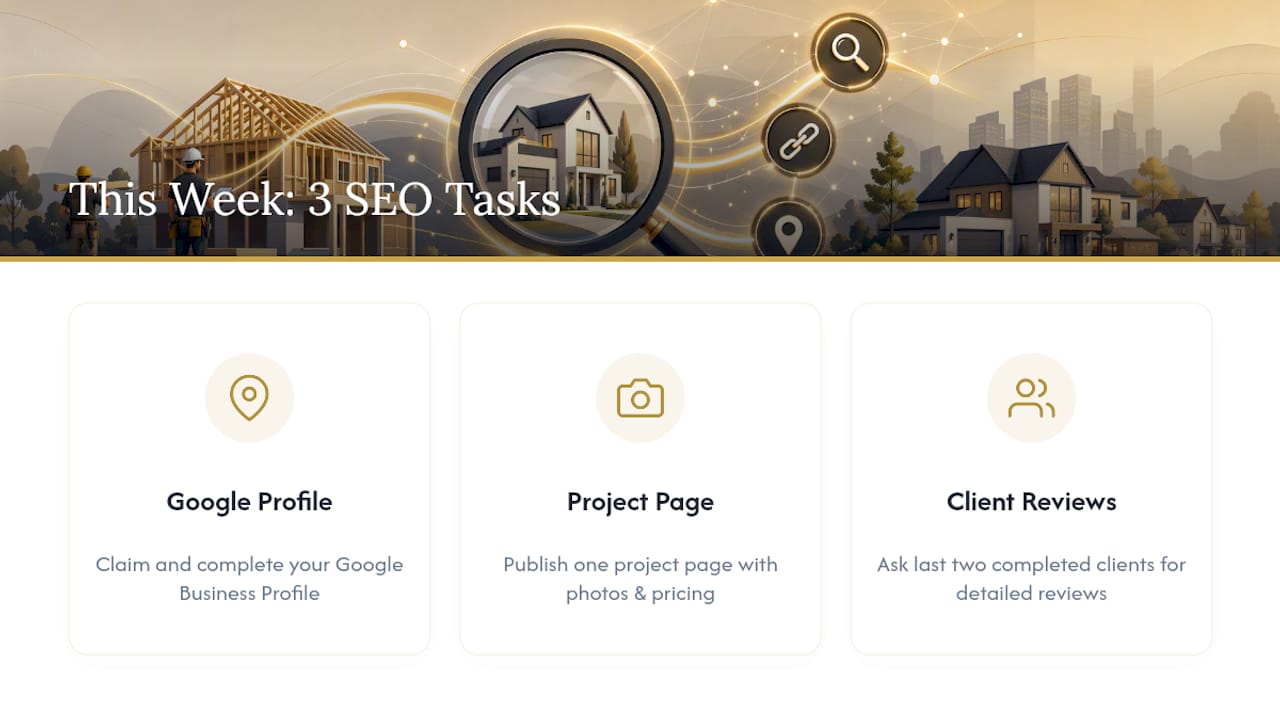
Three things to do this week, no exceptions: claim and complete your Google Business Profile, publish one real project page with actual photos and pricing ranges, and ask your last two completed clients for a detailed review.
The two traps I see most often: builders who buy a template site and never customize the service-area pages beyond swapping city names, and builders who hire an agency for a one-time “SEO fix” instead of an ongoing process, then wonder why rankings faded within months. SEO for builders isn’t a project with an end date. It’s closer to maintaining a job site: skip it for a season and things start slipping.
If your site hasn’t changed in over a year, it’s worth an outside look. Blindspot’s SEO and GEO services page walks through what that audit typically covers.
— Harry
Blindspot’s Builder SEO Services
There are agencies that focus on immediate lead generation for builders rather than lengthy website redesigns. We work on what you already have: your Google Business Profile, your existing project photos, your current site structure, and we build outward from there instead of starting over. Services include SEO and AI/GEO optimization, Google Business Profile management, project-page content creation, and structured review outreach so your best clients actually leave the detailed reviews that move rankings.
This fits builders and contractors who have steady project work but inconsistent inbound leads, especially if you’re relying on referrals alone and want a second, more predictable channel running alongside them. Some agencies have experience working with various industries, including trades and installers facing local competition similar to builders.
The process starts simple: a site and GBP audit, a proposal scoped to what actually needs fixing, then an ongoing monthly program once you’re ready to move. Check out our work or start with a straightforward SEO and GEO consultation.
Sources
- Statista: Frequency of internet use for home searching in the U.S. by age group
- Scale Growth Digital: Digital marketing for construction


