8 Testimonial Video Examples: 3 Copyable Scripts for Marketers
Testimonial videos convert because real customers tell concrete stories that prospects recognize and trust. Below are eight examples worth studying, each built around a different technique you can copy, along with capture scripts and distribution tactics. Online video already claims a huge share of daily time spent online, and companies like HubSpot have built entire libraries proving what separates a forgettable clip from one that closes deals.
TL;DR:
- Testimonial videos perform better when customers speak unscripted, open with specific results, and include on-camera metrics for authenticity.
- Short clips under two minutes that focus on one benefit and are designed for sound-off social feed viewing tend to generate more engagement.
- Using a simple, logistics-based capture process and matching the video’s emotional tone results in more genuine and impactful testimonials.
- Different formats serve distinct marketing goals: long case studies for sales, short social clips for awareness, and montages for broad social proof.
- Incorporating transcribed testimonials enhances SEO and multiplies content value from a single customer interview.
Table of Contents
- What Makes a Testimonial Video Actually Work
- Eight Testimonial Videos and the Technique Each One Teaches
- Matching the Format to Your Marketing Goal
- How to Capture Great Testimonials: Questions and Scripts
- Getting More Value Out of One Testimonial Shoot
- Blindspot’s Perspective on Producing Testimonials for Local Businesses
- How Blindspot Supports Testimonial Video Production
- Sources
What Makes a Testimonial Video Actually Work
Most testimonial videos fail for the same reason: they sound scripted. The strongest ones open with the customer’s own words, not a narrator’s setup. Lemonlight’s research into high-performing testimonials found that a 5 to 8 second opener where the subject states the core result, before any branding or context, holds attention better than a slow build. That single production choice separates a video that gets skipped from one that gets watched to the end.
Concrete numbers matter more than adjectives. “This software changed everything” convinces nobody. “We cut onboarding time from six weeks to nine days” convinces a buyer who has that exact problem. The best testimonial clips pair a specific metric with a human voice saying it out loud, on camera, unscripted.
Here’s what separates a testimonial video that gets forwarded internally from one that gets ignored:
- Unscripted quotes: real hesitation, real phrasing, not a read-aloud paragraph
- One hard number: hours saved, percentage improvement, revenue lift, cited on screen
- Visual proof: B-roll of the product in use, screenshots, before-and-after shots layered under the voice
- A clear subject: job title and company name on screen within the first few seconds
- Tight runtime: most effective clips run 60 to 120 seconds for social, longer only for dedicated case-study pages
Single-customer stories work best when the buyer needs to see themselves in a specific scenario, like a security company deciding whether an alarm system fits a property like theirs. Montages work better for broad social proof, when the goal is volume of voices rather than depth of story.
Pro Tip: Ask your happiest customer for one specific number before you ever turn on a camera. If they can’t name a metric in the pre-interview call, the video will lean on vague praise instead of proof, and vague praise doesn’t move buyers.
Online video’s growing share of daily attention means a mediocre testimonial doesn’t just underperform, it gets scrolled past in seconds. Production quality doesn’t need to be expensive, but it does need to be intentional: clean audio, steady framing, and captions for sound-off viewing on social feeds.
Eight Testimonial Videos and the Technique Each One Teaches
Some of the clearest examples of testimonial video technique come from companies most marketers already know. What matters isn’t the brand, it’s the specific choice each one made and why it worked.
-
HubSpot’s customer story format. HubSpot’s own library of testimonial video examples leans hard on named metrics stated by the customer, not a voiceover. The technique: let the subject say the number themselves, on camera, so it reads as a claim they’re making, not one the brand is making about itself. The takeaway is simple. If your customer can say “we grew leads by 40%” in their own words, cut everything else and build the video around that sentence.
-
Salesforce’s Trailblazer series. Salesforce built an entire content pillar around customer “Trailblazers,” individuals who solved a specific business problem using the platform. The technique here is narrative continuity: instead of a one-off clip, each story connects to a recognizable character across multiple pieces of content. The takeaway: if you have a genuinely compelling customer, don’t burn them in a single 90-second video. Spread their story across a short clip, a longer case study, and a quote graphic.
-
Dropbox’s workflow-focused case study. Dropbox has used testimonial content that shows the product inside a real workflow rather than talking about it abstractly, a pattern Dock’s catalog of B2B testimonial formats identifies as one of the more durable formats for software buyers. The technique: intercut interview footage with actual screen capture of the tool being used. The takeaway: never let a testimonial run more than 10 seconds without cutting to proof.
-
Amazon’s operational case study style. Amazon’s fulfillment-side customer content often centers on measurable business impact, framed around before-and-after numbers that a logistics buyer can immediately map onto their own operation. The technique: open with the problem state, not the solution, so the improvement lands harder. The takeaway: film your customer describing the bad old days before you ask them to describe the fix.
-
Asana’s customer montage approach. Asana has used short-form montage testimonials that string together several customers each stating one benefit, rather than one deep story. The technique: volume of voices over depth of narrative, useful when the goal is breadth of social proof across different industries. The takeaway: montages work best when every clip states a different benefit. Repetition kills the format.
-
Hootsuite’s social-native testimonial clips. Hootsuite has produced testimonial content built specifically for social feeds rather than repurposed from a longer shoot, with captions burned in and the key line delivered in the first three seconds. The technique: design for sound-off viewing from the start. The takeaway: if the clip only makes sense with audio on, it won’t survive a social feed.
-
Vocal Video’s scaled capture model. Vocal Video’s case study on how BookLife by Publishers Weekly used a link-based capture tool shows a different lesson entirely: the technique isn’t in the editing, it’s in the logistics. Sending customers a simple recording link instead of scheduling a production crew multiplied the number of usable testimonials the team collected. The takeaway: sometimes the biggest unlock is removing friction from capture, not improving the final cut.
-
Lemonlight-produced case study work. Lemonlight’s own breakdown of seven testimonial videos done right repeatedly points to one production choice: matching the emotional register of the edit to the customer’s actual delivery, rather than imposing upbeat music over a subdued, thoughtful answer. The technique: let the edit follow the interview’s tone, not a template. The takeaway: watch the raw footage twice before you touch the timeline.
Matching the Format to Your Marketing Goal
A 90-second case study film and a 15-second social clip aren’t different lengths of the same thing. They’re different tools for different jobs.
- Long-form case study (2 to 4 minutes): best for sales enablement, embedded on a dedicated page a prospect visits mid-consideration. Structure: open on the result, show the problem, walk through the solution, close on a second, stronger quote.
- Short social clip (15 to 60 seconds): best for top-of-funnel awareness. Open with the strongest line in the first 3 seconds, no slow build.
- Montage (60 to 90 seconds): best for broad trust-building on a homepage or ad, several customers each making one point.
- Micro-ad cutdown (6 to 15 seconds): best for paid social retargeting, a single quote with a caption and a logo.
Captions are non-negotiable across every format since most social platforms default to sound-off autoplay. Vertical framing (9:16) for social, horizontal (16:9) for case-study pages embedded on a website. If you’re only producing one format, pick based on where the buyer actually makes the decision, not where you have the most footage.
How to Capture Great Testimonials: Questions and Scripts
Before any camera turns on, confirm three things with the customer: written consent to use their name and likeness, their preferred recording method (in-person, video call, or a self-recorded link), and a short briefing note so they know roughly what you’ll ask.
The interview questions that produce usable footage almost always ask for a number or a moment, not an opinion:
- What specific problem were you trying to solve before you found us?
- What changed, in numbers if you have them, hours, dollars, percentage?
- What almost stopped you from working with us?
- What would you tell someone on the fence right now?
For scripting, resist writing full answers for customers. Bonjoro’s guidance on testimonial scripts recommends giving customers prompts, not lines, which keeps the language authentic while still steering toward outcomes. Three templates worth adapting: a B2B case-study prompt sheet focused on time and cost metrics, a long-term B2C loyalty prompt focused on why they stayed, and a 15 to 30 second social prompt asking for one sentence they’d say to a friend.
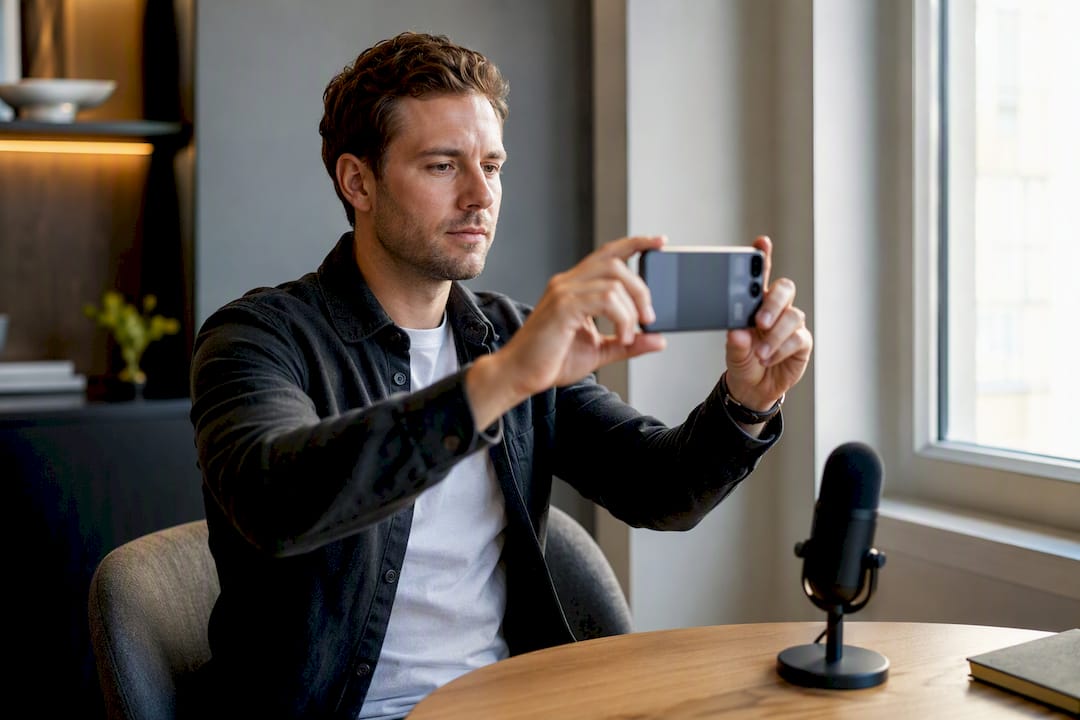
Pro Tip: For remote capture, ask customers to film near a window facing the light, not with it behind them, and to hold the phone horizontally. That one instruction fixes most of the lighting and framing problems you’ll otherwise spend an hour trying to salvage in editing.
Getting More Value Out of One Testimonial Shoot
One well-run interview can produce a dozen usable assets if you plan the cuts before you shoot. B2B buyers respond best to testimonials placed on pricing and case-study pages; consumer buyers respond better to testimonials embedded in social ads and checkout flows.
- Cut a 15-second version for paid social and a 60-second version for organic posts
- Pull the strongest single line as a quote graphic for email campaigns
- Embed the full clip on the relevant landing page and transcribe it for on-page SEO text
- Track conversion lift on pages where the testimonial is embedded, not just view count, since that’s the metric that actually reflects B2B content performance
- Run a small A/B test comparing the page with and without the embed before rolling it out everywhere
Repurposing this way turns one shoot into a quarter’s worth of content rather than a single asset that gets used once and forgotten.
Blindspot’s Perspective on Producing Testimonials for Local Businesses
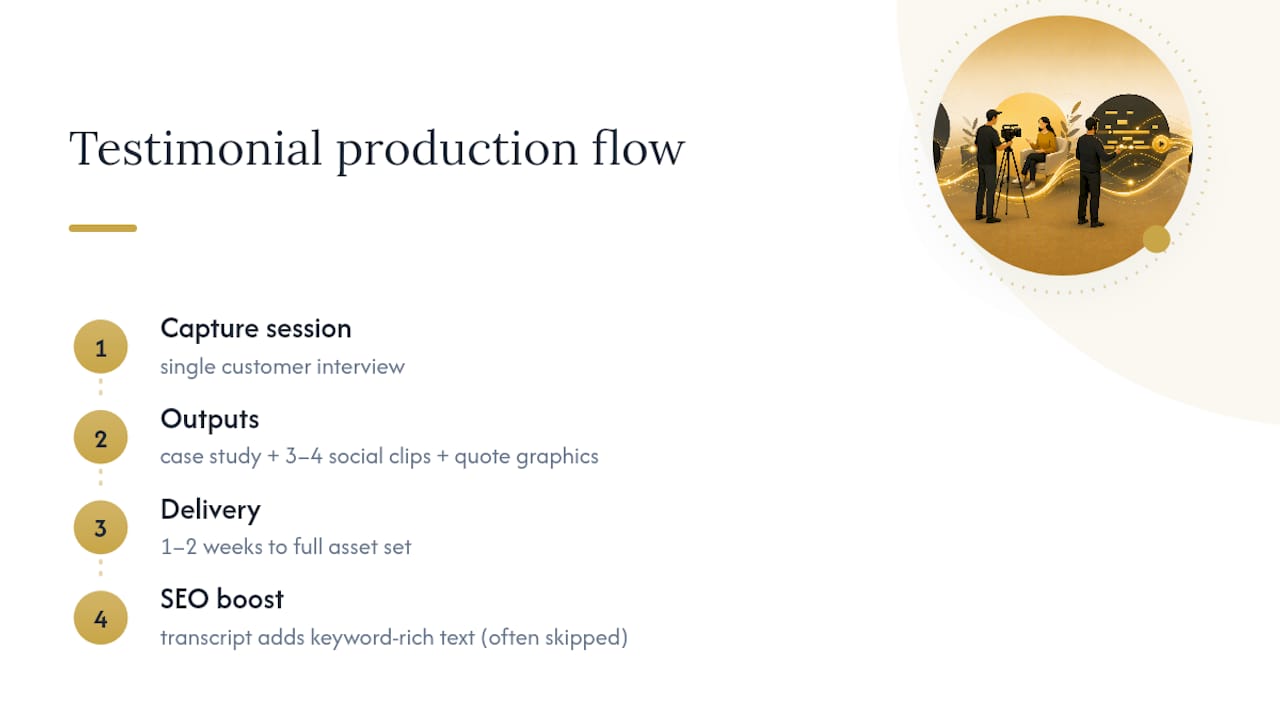
For local-service clients, security companies, installers, builders, testimonials work best woven directly into the systems already driving enquiries: a Google Business Profile, a service page, a social feed. A single customer interview typically produces a long-form case-study cut, three or four social-length clips, and a quote graphic set, all sourced from one capture session.
Timelines usually run one to two weeks from interview to delivery of the full asset set, including micro-cuts for social distribution. What tends to get missed is the SEO layer: a transcribed testimonial adds real, keyword-relevant text to a page that would otherwise be thin. That’s the piece most local businesses skip, and it’s often the easiest win in the whole shoot.
— Harry
How Blindspot Supports Testimonial Video Production
If you’ve read this far and realized your business has happy customers but no camera crew, an agency can fill that gap for local service businesses. Rather than hiring a one-off production company that disappears after delivering a single file, some agencies handle content creation and video editing as part of an ongoing strategy, so every testimonial supports search visibility and social feeds.
That means the raw interview becomes a case-study page, a set of social cuts, and a transcript that feeds your SEO, all from one shoot. Businesses that need a steady flow of authentic customer content, rather than a single polished video, often lean on Blindspot’s user-generated content service to keep the pipeline moving month to month. Once the assets are cut, Blindspot’s social media marketing team places them where local buyers actually see them. If you want a plan for turning your next happy customer into usable marketing, consider consulting an agency to map out what a shoot and distribution schedule would look like for your business.
Sources
- Statista — Average daily time spent watching online video
- HubSpot — Testimonial video examples
- Lemonlight — 7 powerful customer testimonial videos done right
- Dock — 11 B2B testimonial video examples
- Bonjoro — 7 effective testimonial video examples (+ 3 scripts)


