90 Day Plan for Service Area SEO: Audit, One City Page

Service-area businesses can rank without a shopfront, but only if three things happen in order: a properly configured Google Business Profile, at least one genuinely useful city page, and a steady flow of reviews and citations tied to that page. Fix the profile first, because it moves fastest. Then publish one strong location page before you build ten thin ones. Reviews and citations are what convince Google you actually work where you say you do.
TL;DR:
- Prioritize fixing your Google Business Profile first, focusing on accurate service areas, categories, and complete contact details to see quick improvements.
- Build a single, detailed city page for each target town with local-specific content, photos, and reviews, rather than multiple thin or duplicate pages.
- Consistently gather and respond to reviews immediately after jobs, and build citations on relevant directories linked to the correct city pages to enhance prominence.
- Use a geo-grid or location-based rank tracker to monitor local pack presence and rankings for each town regularly, identifying when efforts need adjustment or escalation.
- Focus on a 90-day plan: optimize your GBP, publish key city pages, implement a review system, test local offers, and analyze results before expanding to additional towns.
Table of Contents
- What is a service-area business and how do its local rankings work?
- How do you optimise Google Business Profile for a service-area business?
- How do you build service-area pages that actually rank?
- What counts as a doorway page, and how do you avoid it?
- How do reviews and citations build prominence for a service-area business?
- How do you measure whether it’s working across multiple towns?
- What does a 90-day plan to target one new city look like?
- Blindspot practitioner notes and proof points
- What matters most when you’re doing this yourself
- How Blindspot can help with service-area SEO
- Sources
What is a service-area business and how do its local rankings work?
A service-area business (SAB) serves customers at their homes, offices, or job sites rather than welcoming them into a shop. Locksmiths, HVAC engineers, cleaning firms, mobile pet groomers, and most builders fall into this category. Plenty of trades run a hybrid: a small showroom or workshop that customers rarely visit, alongside a fleet of vans doing the real work across a wider patch. Google treats these hybrids differently from pure SABs, so it matters which one you actually are.
Local rankings hinge on three factors: relevance, distance, and prominence. Relevance is whether your listing matches what someone searched for. Distance is how far you sit from the searcher, and this is where SABs struggle, because Google Business Profile requires SABs to hide their public address, which removes the fixed point Google would normally measure proximity from. Prominence, built from reviews, citations, and links, is the lever most SABs can actually pull to offset that distance disadvantage.
That’s the practical shape of the problem:
- Relevance gets fixed through categories, services, and page content.
- Distance decays the further a searcher sits from your operating base, and you cannot fully control it.
- Prominence is earned through reviews, citations, and links, and it’s the one signal that compounds over time.
There’s a ceiling to what optimisation alone can achieve. If you’re consistently invisible in a town 25 miles from your base while a local competitor with a genuine address dominates, no amount of on-page tweaking closes that gap. At that point, a satellite location with real staff presence becomes the honest answer, not another page.
How do you optimise Google Business Profile for a service-area business?
Your GBP listing is the single fastest lever you have. Most of the changes below can be live within a day, and some show movement in the local pack within weeks.
- Set service areas by realistic travel time, not a neat radius. Think about which towns you’d actually accept a job in on a normal Tuesday, not which ones look tidy on a map. Google lets you list up to 20 service areas per profile, but listing all 20 with no real activity in most of them dilutes relevance rather than building it.
- Choose one precise primary category. “HVAC contractor” beats “home improvement” every time. Add secondary categories only when they genuinely reflect services you offer.
- Fill out the services section in detail, using the exact phrases customers type into Google, not internal jargon.
- Add complete contact details, including a working phone number that’s actually answered during business hours, and a booking link if you have one.
- Upload real photos. Vans with your livery, the team on-site, finished jobs. Stock imagery does nothing for local trust signals.
- Link your profile to the matching city page on your website rather than your homepage, so the click lands somewhere specific to that search.
- Use GBP attributes and post regularly. Weekly posts about completed jobs, seasonal offers, or service updates keep the profile active, which Google rewards with more impressions.
- Verify with a genuine operating address, even though it stays hidden from public view. Virtual offices and PO Boxes risk suspension if Google cannot confirm you operate from where you say you do.
Pro Tip: Set a recurring 15-minute slot every Monday to add one GBP post and check for new reviews needing a reply. Profiles that go quiet for months lose momentum that takes far longer to rebuild than to maintain.
How do you build service-area pages that actually rank?
A city page earns its place in the index by being useful to someone who lands on it, not by repeating your homepage with a different town name swapped in. Get the structure right and the page becomes the “final destination” Google wants to send searchers to, rather than a signpost to somewhere better.
Start with the basics. URLs should read cleanly, something like /emergency-plumber-worthing, with the city and service both present. Title tags need the same combination, written for a human first: “Emergency Plumber in Worthing | 24/7 Callout” beats a keyword-stuffed alternative every time. Meta descriptions should state what the visitor gets and by when. On the technical side, mark up the page with Schema so machines read the same location signals a person would.
Content is where most pages fail. A page that says “we cover Worthing too” in one sentence gives Google nothing to rank. A page that actually earns rankings includes:
- Specific services offered in that town, not a generic list copied across every page.
- Typical response times for call-outs in that area.
- Pricing cues, even rough ones, so visitors know roughly what to expect before calling.
- Photos from real jobs completed nearby, not stock photography.
- A testimonial or review specific to that location, where you have one.
Search Engine Land’s guidance on this is blunt: the pages that succeed solve a task for that specific searcher, like confirming you cover their postcode and telling them how fast you’ll arrive, rather than just asserting coverage.
Roughly 800 words is a sensible target for a page with real substance, though a tight, useful page at 500 words beats a padded one at 1,200. The moment you find yourself writing filler to hit a word count, that’s the signal you’ve run out of genuine local detail, and a store-locator style index page for the smaller surrounding towns will serve visitors better than another thin page.
Link every city page from your main navigation or an HTML sitemap, never bury it three clicks deep with no path in. If you’re weighing how much a page needs to do versus simply state, the same logic used in conversion-focused client work applies here: give the visitor a reason to act on this page specifically, not a reason to click away and search again.
What counts as a doorway page, and how do you avoid it?
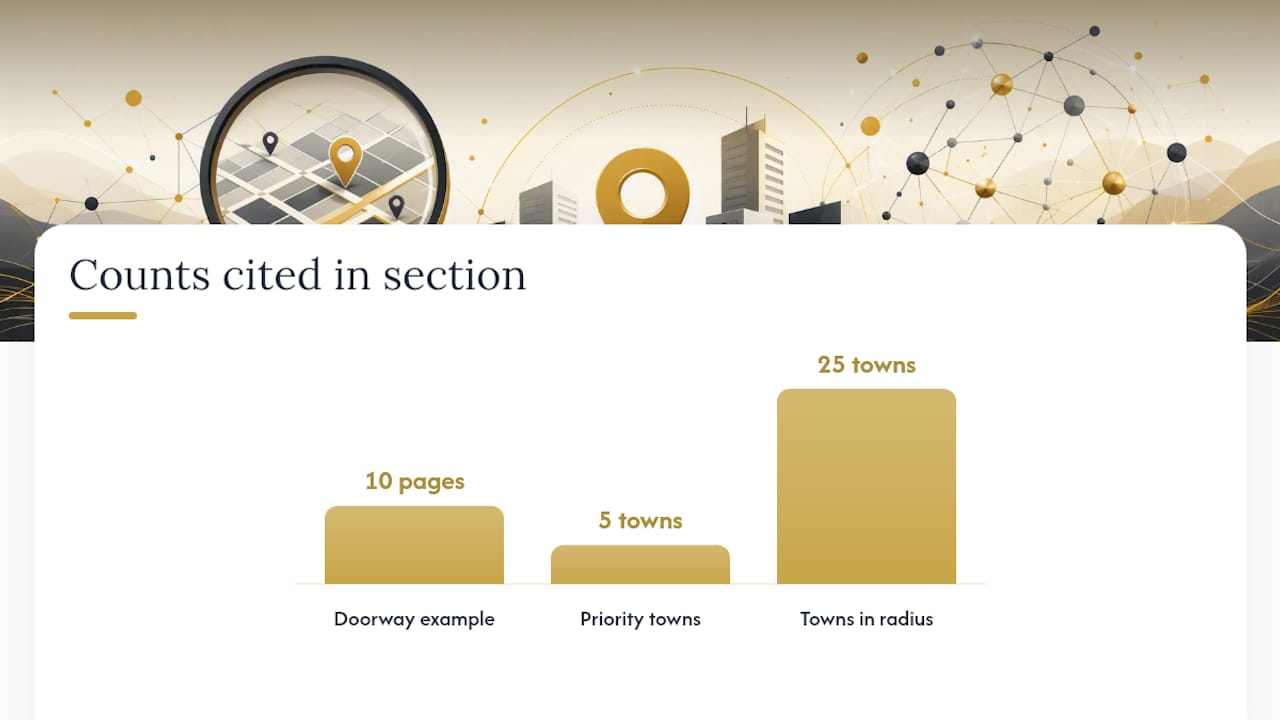
Google’s own definition of a doorway page is one built to rank for a search term while funnelling every visitor to the same generic destination regardless of which page they landed on. Ten city pages with identical text except for a swapped town name are the textbook example, and Google’s algorithms are good at spotting the pattern.
The decision rule is straightforward: build a unique page only where you can say something genuinely different about that town. That might be distinct response times, local project photos, or specific postcodes covered. Where you can’t, a single well-organised index page or store locator that lists every town you serve, linked clearly from navigation, does the job without the duplicate-content risk.
- Build a full page for towns where you get real search volume and can write real local detail.
- Use an index or locator page for smaller towns where you’d otherwise be repeating yourself.
- Never publish ten pages in a week just to “cover the map.” Prioritise the five towns that generate enquiries, not the twenty-five within your theoretical radius.
Pro Tip: If you’re ever unsure whether a page is a doorway, ask whether a visitor from that town would learn anything they couldn’t get from your homepage. If the answer’s no, delete the page or fold it into an index instead.
How do reviews and citations build prominence for a service-area business?
Reviews carry more weight for SABs than for shopfront businesses precisely because you lack the one signal a physical premises gives away for free: a verifiable address. Prominence, built from reviews, citations, and links, becomes the main lever you have left to pull.
- Ask immediately after the job, not days later. Automated SMS or email requests sent within hours of completion convert far better than a generic follow-up email a week on. Industry playbooks report post-job automated requests converting 25–35% in many trades, a stark difference from delayed, one-off asks.
- Send a direct review link, not a request to “find us on Google.” Every extra step you make someone take loses you a chunk of respondents.
- Encourage detail without scripting the customer. Ask “how was the job in [town]?” rather than handing over exact wording. Genuine mentions of the town and the service build the kind of locality signal Google can’t fake its way past.
- Respond to every review, good or bad, within a couple of days. A pattern of responses shows Google, and future customers, that the profile is actively managed.
- Build citations on directories that matter for your trade, and link each listing directly to the matching city page on your site rather than your homepage. A citation pointing at the wrong page wastes the authority it could have passed on.
Negative reviews need a calmer approach than most owners manage in the moment. Reply factually, offer to resolve the issue offline, and never argue in public. A single measured response to a bad review often does more for trust than five glowing ones, because it shows prospective customers how you behave when something goes wrong.
How do you measure whether it’s working across multiple towns?
A single rank checker on your main keyword tells you almost nothing once you’re serving more than one town. You need visibility broken down by location, tracked over time.
The essential KPIs to watch:
- Local pack (map pack) presence for your priority towns, checked individually.
- GBP impressions and search queries, visible directly in your profile’s performance data.
- Call volume and click-to-call events tied to each city page.
- Organic ranking position for your core service terms, per city.
A geo-grid tool, or a rank tracker with location-based sampling, checks your rankings from multiple simulated points across a town rather than one central postcode. This matters because a business can rank first in the centre of a town and vanish entirely three miles out, and a single check point would never show you that.
| Metric | What it tells you | Typical review cadence |
|---|---|---|
| Local pack presence | Whether you appear in map results for the town | Weekly |
| GBP impressions/queries | How often and for what terms you’re shown | Monthly |
| Calls/clicks from GBP | Whether visibility is converting to enquiries | Monthly |
| City-page organic rank | Whether the page itself ranks outside the map pack | Fortnightly |
GBP category and profile fixes tend to move fastest. In less competitive markets, changes can show up in the local pack within two to four weeks, while content and citation-driven authority build over months, not weeks. If, after several months of consistent effort, a town still shows no movement despite genuine investment, that’s your signal to weigh a satellite location rather than pouring more budget into pages for a market you may never crack from a distance.
What does a 90-day plan to target one new city look like?
Pick one target town before you do anything else. Spreading effort across five towns at once means none of them gets enough attention to move.
- Weeks 1 to 2: audit and fix GBP for the target area, add services, upload real photos, verify contact details.
- Weeks 3 to 4: write and publish one genuinely useful city page, with schema markup and internal links from your main navigation.
- Weeks 5 to 8: launch a systematic review request process for every job completed in that town, and build citations on the directories your trade actually appears on.
- Weeks 9 to 10: test one small experiment, a stated response-time guarantee, a dedicated local photo gallery, or a one-off local offer, and watch whether enquiries shift.
- Weeks 11 to 12: report on movement across the KPIs above and decide whether to repeat the process for a second town or keep investing in the first.
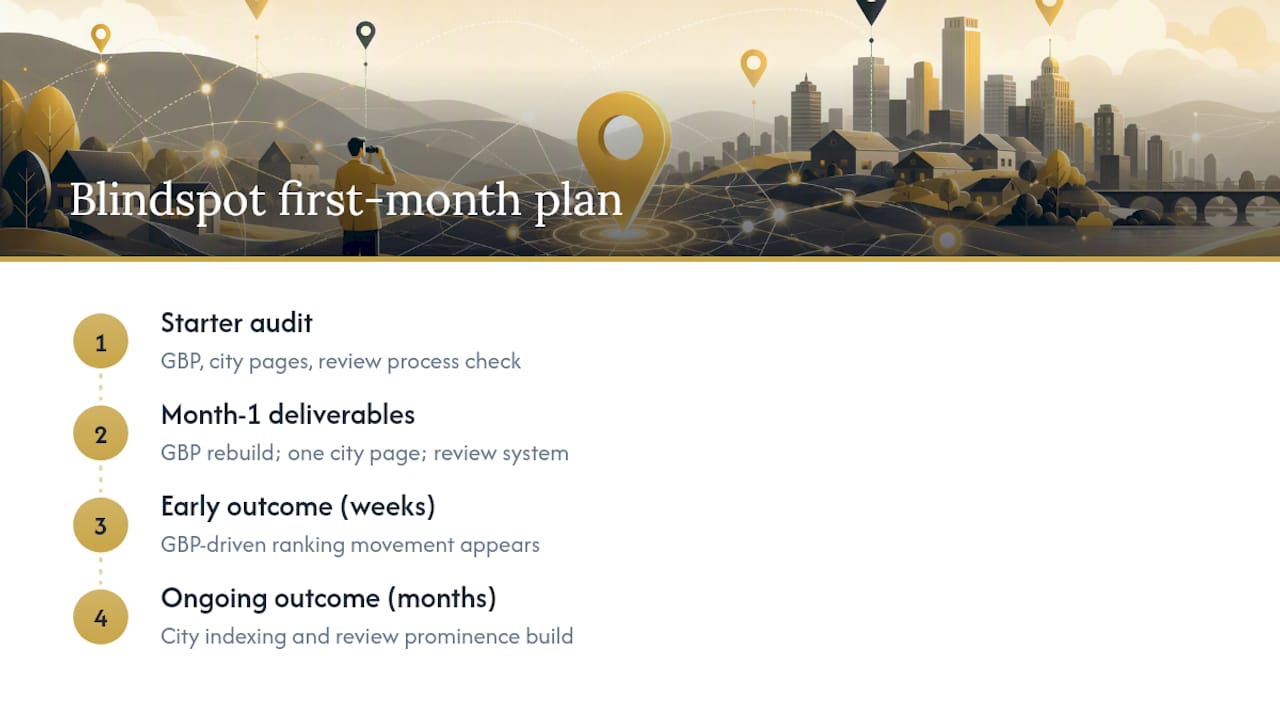
Expect early GBP-driven movement by day 30, city-page indexing and early ranking signals by day 60, and a clearer read on whether reviews and citations are shifting the map pack by day 90. That’s a realistic window, not a guarantee.
Blindspot practitioner notes and proof points
Blindspot works with local trades across Sussex, including security firms, builders, and blue-collar services, on exactly this kind of local search work. The pattern that shows up again and again with these clients: businesses that treat GBP as a one-time setup task, rather than something to maintain weekly, plateau fastest. The ones who commit to a steady review cadence alongside even a handful of genuinely useful city pages consistently outpace competitors who publish dozens of thin, near-identical location pages.
Blindspot’s SEO, local SEO, and Google Business Profile optimisation work is built around that same order of priorities: profile fixes first, quality pages second, prominence built through reviews and citations third. Specific case studies and performance figures for individual client campaigns will be added here as results are published.
What matters most when you’re doing this yourself
If there’s one thing worth fixing before anything else, it’s this: prioritise reviews and a handful of genuinely strong city pages over a sprawling network of thin ones. Most SABs get this backwards, chasing coverage of every town within driving distance before they’ve earned trust in even one.
The three mistakes I see most often: setting GBP service areas by ego rather than by where jobs actually happen, publishing city pages with swapped town names and nothing else changed, and going quiet on review requests the moment the job’s done and the invoice is paid. Fix those three and most of the ranking problem solves itself. If you’re not sure where your profile or your pages currently stand, an audit will tell you faster than guessing.
— Harry
How Blindspot can help with service-area SEO
There are alternatives to traditional agency retainers for businesses trying to rank across several towns without a shopfront in any of them: instead of a generic package, start with an audit that looks specifically at your GBP setup, your existing city pages (if any), and your review process, then tells you which of the three priorities above needs attention first.
A typical first month covers a full GBP rebuild, one properly built city page for your priority town, and a review request system set up to run automatically after every job. Early GBP-driven movement is realistic within the first few weeks; city-page indexing and review-driven prominence build over the following months as citations and testimonials accumulate. Local SEO and content work can also draw on user-generated content from real completed jobs, the kind of local photo and testimonial material that separates a genuinely useful city page from a thin one.
If you want a clear view of where your current setup stands and what to fix first, get in touch through Blindspot’s SEO & GEO services page and request a starter audit.
Sources
For readers who want to go deeper: Search Engine Land’s guide to service area pages covers doorway-page avoidance in detail; BrightLocal’s GBP guidance for SABs explains profile settings precisely; Ahrefs on local SEO breaks down relevance, distance, and prominence; and schema.org’s LocalBusiness documentation covers the structured data properties referenced above.
- Service area pages: Boost local SEO across locations
- Local SEO for Service-area Businesses
- Local SEO (Ahrefs)
- Schema