90 Day SEO That Gets Calls for Plumbers via Google Business Profile

If you want more booked jobs this quarter, focus on Google Business Profile and service pages that answer emergency intent first. Get your profile fully optimised, publish two or three tightly written service pages, and turn on call tracking. Expect Google Business Profile and review activity to shift within weeks, with a measurable lift in booked jobs within a few months. Watch two numbers above all else: calls from your Google Business Profile and organic-attributed jobs actually booked.
TL;DR:
- Prioritize optimizing your Google Business Profile and generating consistent reviews to see measurable booked job increases within a few months.
- Focus on creating one well-targeted service page per core offering with location details, ensuring fast mobile load times and structured data for better local visibility.
- Maintain ongoing review collection, respond within 48 hours, and check citations quarterly to boost your Map Pack ranking through review velocity and local signals.
- Implement a straightforward 90-day plan starting with profile verification, emergency page updates, and speed fixes, then scale content and review automation systematically.
- Budget varies from less than £300 monthly for DIY tools to several thousand pounds for agency support, with organic leads becoming more cost-efficient over paid channels over time.
Table of Contents
- Why SEO for plumbers works differently to other trades
- Your revenue-focused 90-day SEO checklist
- How do you optimise Google Business Profile for a plumbing business?
- Building service pages and location keywords that turn clicks into calls
- Winning the map pack: reviews, reputation and citations
- Technical fixes that stop mobile searchers bouncing
- How do you measure whether plumbing SEO is actually working?
- What should you budget and how long until it pays off?
- What a working 30/60/90-day plan actually looks like
- What the industry gets wrong about plumbing SEO
- How Blindspot can help your plumbing business get found
- Sources
- FAQ
Why SEO for plumbers works differently to other trades
SEO for plumbers isn’t about chasing generic rankings for “plumber” and hoping for the best. It’s about winning the tiny window when someone’s boiler has died at 7am on a Sunday, or when a homeowner is quietly comparing three local firms before a bathroom refit. Those are two completely different searches, and plumbing SEO strategies that treat them the same waste budget on both.
The standard industry term for this discipline is local search engine optimisation, or local SEO, and it behaves differently from national SEO. Rankings hinge on proximity, review signals and Google Business Profile activity rather than domain authority alone. Research from ServiceTitan found a claimed and fully optimised Google Business Profile is often the single biggest short-term lever available to a local plumbing business, because profile completeness and review activity move the Map Pack faster than almost anything else you could do.
That matters because the Map Pack, the block of three local listings that appears above the standard organic results, is where most local plumbing searches actually convert. Web Tonic’s analysis puts Map Pack clicks at over 40% of total clicks on local plumbing queries, with the top three pins absorbing the bulk of that traffic. If you’re not in that block, you’re fighting for scraps further down the page.
This article treats SEO for plumbers as a revenue exercise, not a rankings exercise. Every recommendation below ties back to booked jobs, not vanity metrics like keyword position or impressions.
Your revenue-focused 90-day SEO checklist
Plumbing company SEO doesn’t need a twelve-month roadmap to start producing calls. A tight 90-day sequence, run in the right order, gets the foundation laid and the early wins banked before you invest further.
- Day 0 to 7: Claim or verify your Google Business Profile if you haven’t already, audit your business name, address and phone number (NAP) for consistency across your website and directories, and get call tracking live so every number you publish is measurable from day one.
- Week 1 to 4: Publish or rewrite your emergency service pages, add a click-to-call button that’s visible without scrolling on mobile, and start posting to Google Business Profile at least weekly.
- Month 1 to 3: Launch an automated review request workflow, build three to six new service pages covering your core jobs (boiler repair, blocked drains, leak detection, and similar), and fix any glaring mobile speed issues flagged by PageSpeed Insights.
- Ongoing: Keep posting weekly to Google Business Profile, respond to every review within 48 hours, check your citations quarterly for drift, and review your core KPIs monthly rather than daily.
The order matters more than the detail. Fixing NAP consistency in week six after you’ve already built five new pages means recrawling and reindexing everything, which slows the whole campaign down. Get the boring infrastructure sorted first.
Pro Tip: Don’t wait until all 90 days are planned before you start. Claim your Google Business Profile and turn on call tracking today. Everything else can happen in parallel once those two things are live, and you’ll have a baseline to measure against from week one.
Most plumbing businesses lose weeks here simply because nobody owns the checklist. Assign one person, even if it’s you, and give each task a date rather than a vague “soon”. A 90-day plan with no owner is just a wish list.
How do you optimise Google Business Profile for a plumbing business?
Set your primary category to “Plumber” and add every genuinely relevant secondary category your business offers, such as “Drainage service” or “Water damage restoration service”. Getting this wrong, or leaving it as something generic like “Contractor”, is one of the most common reasons plumbing businesses fail to appear in the Map Pack for the searches that matter most.
From there, the weekly workflow looks like this:
- Fill in the full services list under the Services tab, not just a one-line description, since Google increasingly matches search queries against this structured data.
- Upload five to ten genuine job photos each week: before-and-after shots, van liveries, technicians on-site. Stock photography does nothing for ranking and looks fake to potential customers.
- Post a weekly update, even a short one, covering a recent job, a seasonal reminder (frozen pipes in January, for example), or an offer.
- Automate review requests via SMS immediately after job completion, when the customer’s relief at a fixed problem is freshest.
- Respond to every review, good or bad, within 48 hours. Silence on a bad review reads worse than the review itself.
- Connect your profile to a call tracking tool such as CallRail so every Google Business Profile call is logged against its source, and check Google Business Profile Insights monthly to see how calls, direction requests and website clicks trend.
Pro Tip: Photos with your logo, van, or team visibly present tend to outperform generic job photos in engagement. Google can’t read intent from a picture, but customers scrolling through search results absolutely can, and a recognisable face builds trust before the phone even rings.
The automation piece deserves emphasis. A one-tap SMS review link sent the moment a job is marked complete removes the single biggest point of friction in review generation: relying on a technician to remember to ask. Businesses running this kind of automated workflow consistently generate more reviews, more consistently, than those depending on manual requests.
None of this is exotic. It’s unglamorous, slightly tedious, weekly maintenance. But it’s the maintenance that most competitors skip after the first fortnight, which is exactly why sticking with it separates you from the pack within a couple of months.
Building service pages and location keywords that turn clicks into calls
A generic “Our Services” page listing twelve things you do in one paragraph each will not rank, and even if it somehow did, it wouldn’t convert. Local SEO for plumbers depends on giving Google, and the searcher, one focused page per service, each answering a specific need with a specific intent.
Build one page per core service, and pair it with your location in the title tag and meta description: “Emergency Boiler Repair in Brighton”, not “Boiler Repair Services”. Google reads this pairing as a strong relevance signal, and it matches exactly what someone types when they’re trying to solve a specific problem in a specific place.
Emergency and scheduled searches need entirely different page structures, because the searcher’s mental state is completely different.
Emergency pages (burst pipe, no hot water, blocked drain flooding) should assume the reader has about four seconds of patience:
- Phone number and click-to-call button above the fold, ideally in the header itself.
- A one-line availability statement: “Available 24/7, engineers on the road across Sussex.”
- Trust signals immediately visible: review star rating, years trading, and any relevant certifications.
- Short, scannable steps: what to do right now (turn off the stop tap), what happens when you call, roughly how fast someone arrives.
Research and scheduling pages (bathroom refit, boiler replacement quote, drain survey) get more room to breathe:
- A realistic cost range, even a broad one, because searchers actively want to budget before they commit.
- A plain description of the process, step by step, so the reader knows what they’re agreeing to.
- A short FAQ addressing the three or four questions every customer asks before booking.
- A local case example or two: a real job, even briefly described, grounds the page in reality rather than generic copy.
Every page, whichever type, benefits from local proof stitched directly into the content: genuine job photos, a short note on the specific problem solved, and a review snippet pulled from that job if you have one. This isn’t decoration. Ramp Up Digital’s guide to revenue-focused plumbing SEO found that pages combining service-plus-location targeting with visible local proof converted noticeably better than pages relying on generic stock copy, because the searcher can see the work is real and local rather than templated.
Resist the temptation to spin up a page for every neighbouring town by swapping one place name in an otherwise identical template. Google recognises near-duplicate content quickly, and it dilutes ranking signal across pages instead of concentrating it. Better to build fewer, stronger pages and let genuinely useful local content, not keyword swapping, do the work of reaching neighbouring areas.
Winning the map pack: reviews, reputation and citations
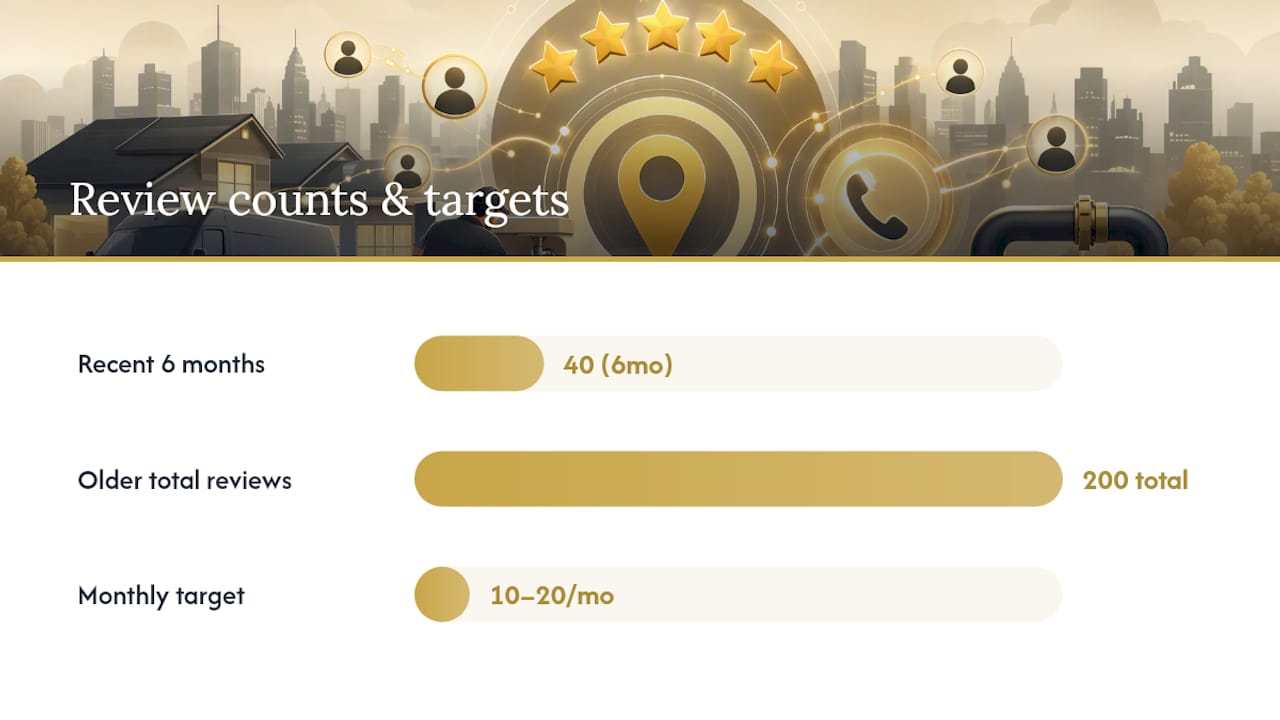
Review velocity, the pace of new reviews arriving rather than the total stacked up over the years, is a stronger local ranking signal than sheer volume. A business with 40 reviews arriving steadily over the past six months typically outranks a competitor with 200 reviews that mostly date from three years ago. PipelineOn’s research backs this up directly, showing recency and consistency of reviews as a driver of Map Pack movement independent of total count.
A workable target for most plumbing businesses chasing growth is 10 to 20 new reviews a month until you’ve built a comfortable baseline, then a steady trickle to maintain velocity after that.
- Send a one-tap SMS review link the moment a job is marked complete in your system, while the relief of a fixed problem is still fresh in the customer’s mind.
- If you run Jobber, Housecall Pro or ServiceTitan, connect the review request directly into your job completion workflow so it fires automatically without anyone needing to remember.
- If you’re running a smaller operation without that kind of software, a manual fallback works too: a simple text template sent by whoever closes out the job, sent the same day, not a week later when the memory has faded.
- Audit your core UK directories, Yell, Checkatrade, TrustATrader and Google Business Profile itself, for exact NAP consistency. Even small variations (a missing “Ltd”, an old phone number) confuse Google’s confidence in your listing.
Pro Tip: Keep a simple response template ready for negative reviews: acknowledge the specific issue, apologise without being defensive, and offer to resolve it offline with a direct contact. Never argue in public. A calm, professional reply to a bad review often does more for your reputation than the review itself did damage.
Escalation matters too. If a review is clearly fake, abusive, or violates Google’s policies, flag it for removal rather than engaging, but reserve that route for genuine breaches, not just reviews you dislike.
Technical fixes that stop mobile searchers bouncing
Most plumbing searches, especially emergency ones, happen on a phone held one-handed while someone stares at a leaking pipe. If your site loads slowly or hides the phone number, you lose that call before the page has even finished rendering.
- Aim for a Largest Contentful Paint (LCP) under 2.5 seconds and a Cumulative Layout Shift (CLS) under 0.1. Both are measurable free in Google’s PageSpeed Insights.
- Compress images before upload rather than relying on the CMS to do it, and strip out render-blocking scripts you don’t actually need (most site builders load far more than they use by default).
- Put your phone number in the header, visible without scrolling, with a working click-to-call link on every single page, not just the homepage.
- Add LocalBusiness or Service schema markup to your site, and FAQ schema on pages where you’ve genuinely got a relevant Q&A section. This gives Google structured data to match against searches, beyond just the readable text.
- Resist building near-duplicate pages for every town in a 20-mile radius. Use canonical tags to point Google to your strongest version, and put the effort instead into one genuinely useful page covering the wider area properly.
The payoff for fixing speed issues isn’t abstract. SEOTakeoff’s analysis of contractor sites found mobile speed improvements producing call volume increases of 15% to 20%, purely from reducing the number of people who bailed out before the page loaded. That’s not a ranking benefit. That’s people who were ready to call, and almost didn’t because the page took too long.
None of this requires a developer on retainer. Most of it is a half-day’s work with a decent CMS and a willingness to actually look at the PageSpeed report instead of ignoring it.
How do you measure whether plumbing SEO is actually working?
Rankings are not a KPI. A page sitting at position three for a keyword nobody searches for is worthless. The metrics that matter are the ones tied directly to revenue.
- Calls from your Google Business Profile, tracked through Insights or a connected call tracking number.
- Organic-attributed booked jobs, meaning calls or form fills from organic search that your CRM records as an actual completed booking, not just an enquiry.
- Cost per booked job from organic, calculated by dividing your monthly SEO spend by the number of organic-attributed jobs booked that month.
To get numbers you can trust, connect a call tracking tool like CallRail to your Google Business Profile and website, and add a lead source field in your CRM so every job gets tagged at the point of booking, not guessed at later. Web Tonic’s guide recommends exactly this pairing as the baseline setup for attributing booked jobs to organic channels with any real confidence.
Run reporting monthly, not weekly. SEO moves too slowly for weekly numbers to mean much, and chasing week-to-week noise leads to reactive decisions that undo good work. Pull Google Analytics 4 for on-site behaviour, Search Console for query and impression data, and your call tracking export for actual phone conversions, then combine all three into one simple monthly view. That combination, rather than any single tool, is what tells you whether the campaign is working or just looking busy.
What should you budget and how long until it pays off?
Early movement, more Google Business Profile calls, a visible uptick in reviews, tends to show within two to eight weeks of starting focused work. Organic traction on new or rewritten service pages usually takes three to six months to properly settle into rankings. Mature, compounding results, where organic search becomes a genuinely reliable source of booked jobs rather than an occasional bonus, generally take six to twelve months or longer.
Cost bands vary enormously depending on how much you do yourself versus hand off:
- DIY with tools: roughly £0 to £300 a month, covering things like call tracking software, a review automation tool, and perhaps a paid SEO audit tool. Time cost is significant and easy to underestimate.
- Boutique local agency: typically £1,500 to £5,000 a month, covering GBP management, service page builds, review workflows and reporting.
- Enterprise or multi-location agency support: higher again, scaling with the number of locations and the competitiveness of the market.
Once rankings mature, organic leads tend to cost noticeably less per booked job than paid channels. PipelineOn’s data puts organic cost per booked job at roughly $25 to $100 in some markets, against $145 to $247 for paid search leads in the same conditions. That gap is exactly why running Google Local Services Ads or Google Ads alongside SEO in the early months, then gradually shifting budget as organic matures, tends to work better than picking one channel and abandoning the other. Paid search fills the gap while SEO ramps; SEO then takes over as the cheaper long-term engine.
If budget is genuinely constrained, prioritise Google Business Profile optimisation and review velocity first. They’re the cheapest, fastest-moving levers, and they compound into everything else.
What a working 30/60/90-day plan actually looks like
Blindspot works with local service businesses, plumbers, builders, security firms and similar trades, across Sussex, and the pattern that produces results is rarely complicated. It’s consistent execution on a small number of high-leverage tasks, not a sprawling list of tactics nobody follows through on.
A realistic starter sequence looks like this. Days 1 to 30: full Google Business Profile audit and optimisation, NAP consistency check across directories, call tracking installed, and the first two emergency service pages published. Days 31 to 60: three to four additional service pages live, an automated review workflow running, and the first round of technical fixes (speed, schema, click-to-call) completed. Days 61 to 90: review volume trending upward, first organic-attributed bookings showing in CRM data, and a monthly reporting rhythm established using GA4, Search Console and call tracking exports together.
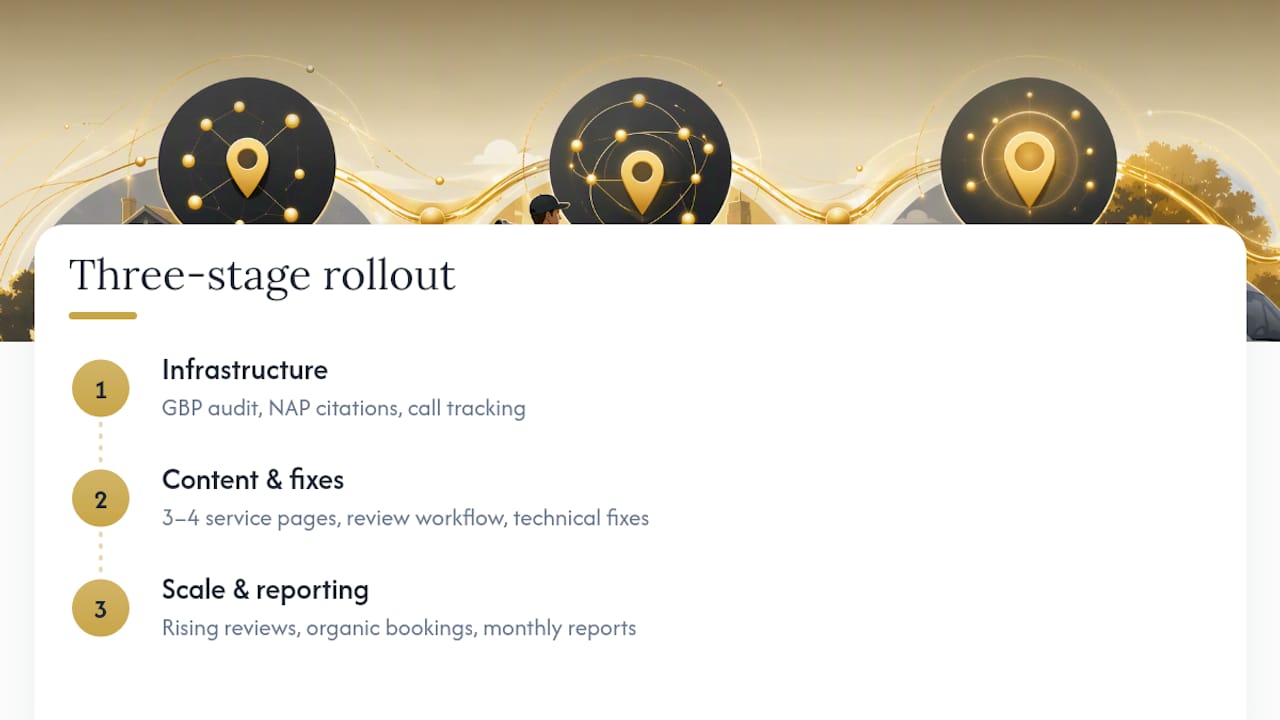
This mirrors what Ramp Up Digital’s playbook recommends as a sequencing model, and it’s the same order Blindspot follows when starting work with a new trade client: infrastructure first, content second, scaling third. Deliverables typically include GBP management, service and location page builds, review automation setup, and monthly attribution reporting, the same building blocks covered throughout this guide, just executed with dedicated time rather than squeezed between jobs.
What the industry gets wrong about plumbing SEO
Most advice aimed at trades businesses treats SEO as a technical problem: fix your title tags, build some links, wait. That’s backwards. The plumbers who actually win more work treat SEO as a reputation and responsiveness problem that happens to be measured by Google.
The conventional wisdom oversells content volume and undersells review velocity. I’ve seen plenty of sites with fifteen well-written service pages sitting behind a Google Business Profile that hasn’t had a photo uploaded in eight months, and they’re invisible in the Map Pack regardless of how good the writing is. Reviews and profile activity move faster and matter more than most agencies admit, probably because they’re less billable than a content sprint.
The other overlooked point: plenty of “plumbing SEO” guides are written by software vendors trying to sell you a dashboard, which quietly shifts the advice toward vanity ranking metrics rather than booked jobs. Rankings don’t pay bills. Calls that convert to jobs do.
If you take one thing from this article, prioritise Google Business Profile completeness and review velocity ahead of everything else in the first month. Everything downstream, service pages, technical fixes, link building, works better once that foundation is genuinely solid.
— Harry
How Blindspot can help your plumbing business get found
Our agency offers an alternative to traditional retainers that treat SEO as a rankings report rather than a revenue engine, tailored for plumbing businesses. The work covers Google Business Profile management, AI search optimisation, review automation, and service and location page builds—all tracked back to actual booked jobs rather than keyword positions nobody can spend.
A typical first step is a discovery audit: a look at your current Google Business Profile completeness, your existing service pages, your review velocity, and your competitors’ Map Pack presence in your specific area. From that, you get a prioritised list of what to fix first, not a generic template. The agency has experience working with various industries including builders, security firms and other trades that depend on local search, achieving improved search rankings for clients in competitive local markets.
If you’d rather hand the 90-day checklist above to people who run it daily, visit the SEO & GEO service page to see how an audit works and what a first engagement typically includes.
Sources
- SEO for Plumbers: The Definitive Guide 2026 | ServiceTitan
- SEO for Plumbers: What Actually Books Jobs in 2026 | PipelineOn
- SEO for Plumbers: Complete Playbook for 2026 | Web Tonic
- SEO for Plumbers: The Complete Guide | SEOTakeoff
FAQ
What is the best way to advertise as a plumber?
A combination of an optimised Google Business Profile, active review generation, and targeted service pages tends to outperform any single channel, because it captures both emergency searches and research-stage comparisons. Pairing that with Google Local Services Ads while your organic rankings mature covers the gap in the early months.
How much does SEO cost in the UK?
Costs range widely: DIY tools run roughly under a few hundred pounds a month, boutique local agencies typically charge a few thousand pounds a month, and enterprise or multi-location support costs can be significantly higher depending on scope. The right budget depends on how competitive your local market is and how much time you can commit yourself.
What is the 80/20 rule for SEO?
Applied to plumbing SEO, the 80% of results tends to come from the 20% of effort spent on Google Business Profile optimisation, review velocity and a handful of well-built service pages, rather than from chasing every possible keyword or building dozens of thin location pages.
Will AI replace plumbers?
No. Plumbing is hands-on, physical work that AI cannot perform, though AI-driven search tools are changing how customers find and choose plumbers, which is exactly why AI search optimisation alongside traditional SEO is becoming part of a complete local visibility strategy.
How long before plumbing SEO shows results?
Early Google Business Profile and review movement typically appears within two to eight weeks, organic service-page traction usually settles in over three to six months, and mature, compounding results generally take six to twelve months or longer to fully establish.