12 Local Link Building Tactics for Local Businesses AI Will Recommend

Local link building means earning backlinks from websites that are geographically or topically tied to your business area, and it still decides who shows up first in Google’s Local Pack and in AI answers. The priority is editorial links from local news, chambers and genuine partners, backed by consistent citations and a complete Google Business Profile. Start this week: audit your existing link and citation profile, then pick one sponsor, supplier or local media contact and ask for the link directly.
TL;DR:
- Local backlinks from community media, chambers, and partners outperform generic high-authority links for local ranking impact.
- Reclaiming existing unlinked mentions can be faster and more effective than building new links from scratch.
- Prioritizing partnership-based links and hyperlocal sources yields higher relevance and easier acquisition than cold outreach.
- A simple scoring model helps focus efforts on prospects with the highest potential impact, relevance, and ease of outreach.
- Consistent outreach of 10 to 15 links per month and setting clear metrics can gradually improve local pack visibility and rankings.
Table of Contents
- Why local link building still matters as AI reshapes search
- Where to find your best local link opportunities
- The 12-tactic local link building playbook
- Prioritising prospects and running efficient outreach
- Measuring local link building ROI and setting realistic timelines
- Dos and don’ts: vetting local link opportunities properly
- How Blindspot approaches local link building for Sussex businesses
- Budgeting your effort: when to run this yourself and when to hire
- Get expert help with local link building and GEO visibility
- Sources
- FAQ
Why local link building still matters as AI reshapes search
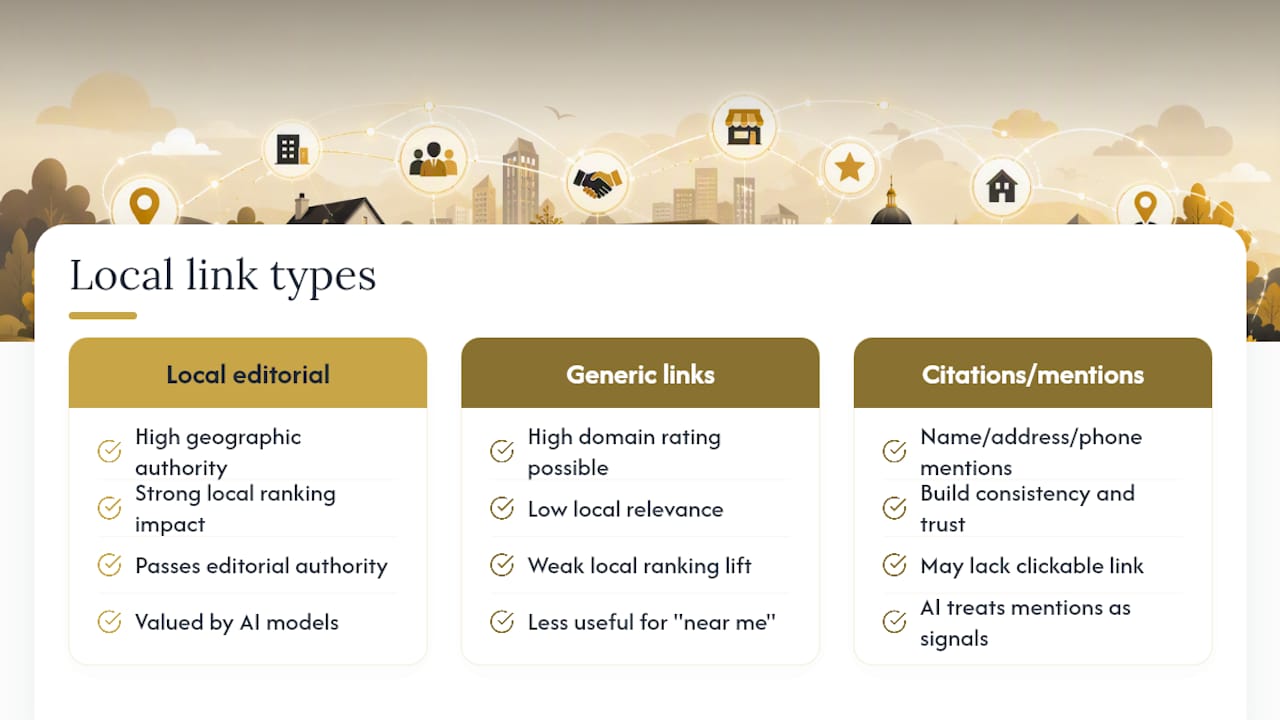
Local backlinks are one of the signals Google weighs when deciding which businesses to surface in AI-driven search results and LLM recommendations, and it tends to favour sources with real geographic authority: local newspapers, industry-specific directories, and Chambers of Commerce. That is a shift worth sitting with. A link from a national directory tells search engines almost nothing about where you operate. A link from your town’s Chamber of Commerce, on the other hand, tells Google (and increasingly, ChatGPT or Perplexity) exactly where you are and who vouches for you.
The gap between local and general backlinks comes down to relevance, not raw authority. A generic link from a high-domain-rating blog based in another country might carry more “SEO weight” on paper, yet it does little for a locksmith trying to rank in Chichester. A single backlink from a locally renowned partner or media outlet frequently outperforms dozens of generic high-domain links for local ranking impact, because it maps directly onto the geographic and topical relevance search engines are trying to measure.
Pro Tip: Before chasing new links, check whether you already have unlinked mentions sitting in local news archives or supplier pages. Recovering this is often faster than building anything new.
AI search tools are already blending link signals with reviews and directory data. Research from BrightLocal found that ChatGPT Search surfaces business websites for 58% of local search sources, with citations and mentions filling the rest with the picture. That means your link profile isn’t just feeding Google anymore. It’s feeding the models that answer “best plumber near me” conversationally.
Citations and backlinks do different jobs, and confusing them is one of the most common mistakes local businesses make. A citation is a mention of your business name, address and phone number on a directory or platform, whether or not it carries a clickable link. Local link building, by contrast, focuses on backlinks that are geographically and topically relevant, the kind that pass genuine authority and referral value. Citations build consistency and trust signals; editorial links build authority and rankings. You need both, but they are not interchangeable, and a business with 200 directory citations and zero editorial links will still struggle against a competitor with 15 strong local backlinks and a tidy citation base.
Linkless mentions, where your business is named without a link, still matter too. They reinforce the same entity signals that citations provide, and AI models parsing local recommendations often treat a mention on a respected local site as meaningful even without a hyperlink attached.
Where to find your best local link opportunities
Not every local link is worth the same effort. Prioritise sources where relevance and authority overlap, and work outward from there.
- Chambers of commerce, BIDs and membership directories. Joining your local Chamber of Commerce or Business Improvement District usually comes with a member listing and a backlink, and it signals genuine local presence to both Google and AI recommendation engines.
- Local news outlets and community media. Regional newspapers, local radio sites and community news blogs frequently cover events, sponsorships and business milestones, and their sponsor or “supporters” pages are often an easy ask once you’ve actually sponsored something.
- Partner and vendor pages. Suppliers, subcontractors and referral partners often maintain “who we work with” or installer directory pages. If you buy from someone regularly, you have leverage to ask for reciprocal recognition.
- Hyperlocal blogs, clubs, sports teams and faith groups. Parish council sites, youth football clubs, and community Facebook-adjacent websites are overlooked by most competitors chasing “high authority” links, yet they carry real local relevance. Hyperlocal sources like community radio and local club pages are consistently high-ROI because almost nobody else is asking for them.
- Industry-specific local directories and trade bodies. A trade association or certification body with a regional chapter (a local guild of builders, a regional HVAC trade body) offers relevance on two axes at once: industry and geography.
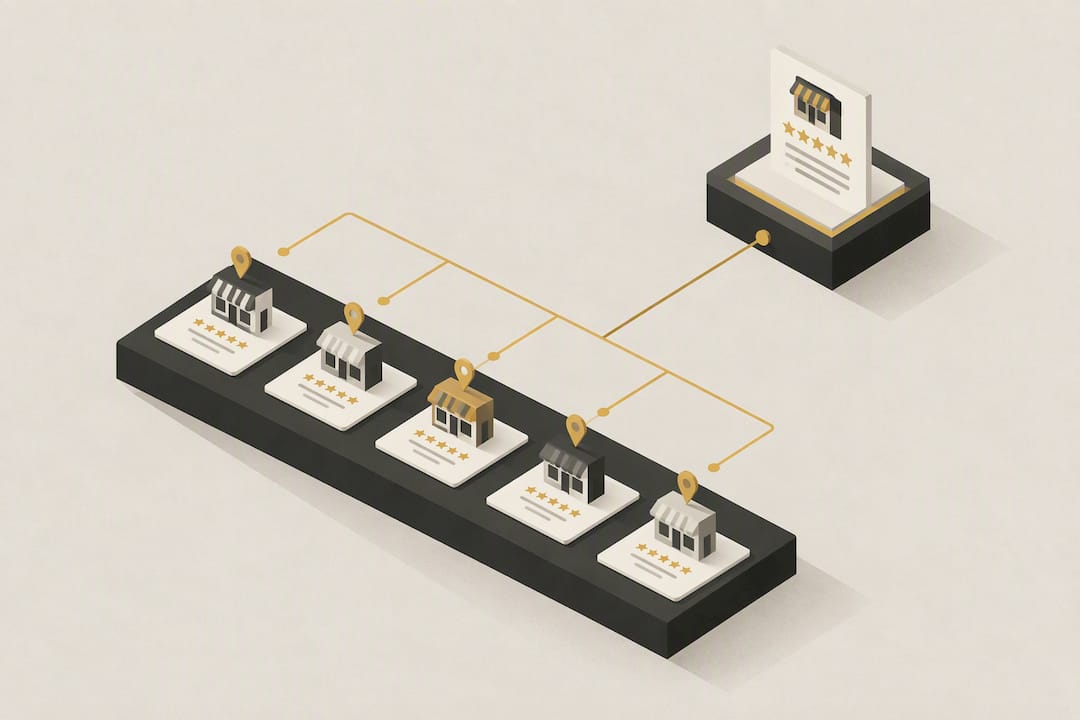
The pattern across all five is the same: relationships beat cold outreach, making it ideal to explore opportunities through the Partner Up | KWOON partner programme for partnership-based link opportunities. The highest-value links for local businesses usually come from ties you already have, suppliers, sponsors, and partners, because they combine genuine relevance with low friction to secure. A locksmith who has bought stock from the same wholesaler for three years has far better odds of getting listed on that wholesaler’s “trusted installers” page than of persuading a stranger at a national blog to link out.
Start close to home literally. Search for your street name, your estate, or your parish council alongside terms like “sponsors” or “local business,” because national SEO tools frequently miss these hyperlocal pages entirely, even though they link out to suppliers and sponsors on a regular basis. A parish council newsletter website with forty visitors a month might never show up in Ahrefs’ link database, but Google still crawls it, and it still counts.
The 12-tactic local link building playbook
This is the execution list. Work through it roughly in order of effort-to-reward, though nothing stops you running several tactics in parallel once you’ve got a rhythm going.
-
Local sponsorships. Pick events with genuine community reach (a school fete, a five-a-side league, a charity fun run) rather than the biggest event you can afford. Email the organiser directly, ask explicitly for a link on the sponsors page as part of the sponsorship terms, and follow up within a week if the page goes live without your link attached.
-
Local digital PR. Local journalists need story angles more than they need press releases. Pitch something genuinely newsworthy: a milestone (tenth year in business), a local hire, a charity partnership, or a reaction to a regional trend. Keep a simple press kit ready: a boilerplate paragraph, a high-resolution logo, and two or three photos, so you can respond to a journalist’s request within the hour.
-
Partner and vendor pages. Make “ask for a link” a standard line item on your post-sale checklist with every supplier and installer partner you deal with. Vendor outreach converts well specifically because the relationship is already warm; you’re not cold-emailing a stranger, you’re asking someone who already profits from working with you.
-
Resource pages and “who to call” pages. Search Google for combinations like “[your service] + [your town] + useful contacts” or “resources” or “recommended tradespeople.” Local council sites, community associations and even estate agent blogs maintain these more often than you’d expect. Email the page owner, point to the exact page, and explain in two sentences why you belong on it.
-
Guest posts and local columns. Regional papers and community magazines often run a “local expert” column. Pitch an editor with three ready-made headline ideas rather than a vague “can I write for you,” and offer something genuinely useful to their readers, not a disguised advert for your services.
-
Reclaim links and unlinked mentions. Search your business name in quotes alongside your town name to find existing mentions with no link attached. Competitor link analysis and link reclamation are established, effective tactics that apply just as well to local SEO as they do to broader link building campaigns. A polite email asking a site to add a hyperlink to an existing mention has a surprisingly high success rate, because you’re asking for a five-minute edit, not a favour.
-
Create local linkable assets. A small, locally original data piece, a survey of neighbourhood habits, a round-up of local event attendance, or a “best of” guide to your town, reliably earns press mentions from multiple local publishers because it gives them something to report on that nobody else has.
-
Run a small local scholarship or award. A modest annual award (£250 to a local student, or a small business grant) gives schools, colleges and local press a genuine reason to link to you. Keep the criteria simple and the application process short, or nobody will apply and the page will look abandoned within a year.
-
Host or attend local meetups. Sponsoring a networking breakfast or hosting a small trade demonstration gives you a natural reason to be listed on event pages, and it builds the kind of real-world relationship that leads to future link requests.
-
Pitch local roundups. Search for “[your industry] + [your town] + best” to find existing roundup posts, then pitch yourself for inclusion with one specific reason you deserve a spot (a certification, an award, a genuinely unusual service).
-
Broken link building on local sites. Run a crawler like Screaming Frog or a free checker across local resource and directory pages to spot dead links, then email the site owner offering your own page as a replacement. It’s slower than most tactics here, but the acceptance rate is high because you’re solving a problem for them.
-
Amplify through social and local platforms. Sharing your sponsorships, press mentions and community involvement on social media doesn’t create links directly, but it puts your business in front of the people who run the pages you want to be linked from, and that visibility often leads to inbound link requests without any outreach at all.
Pro Tip: Log every link request in a simple spreadsheet the day you send it, even the ones that feel too small to matter. Six months later you’ll have a paper trail that shows exactly which tactics converted, and which ones ate time for nothing.
Prioritising prospects and running efficient outreach
Not every prospect deserves the same effort, so score them before you email anyone. A simple model works: Impact × Relevance × Ease, each scored 1 to 5, multiplied together to give you a rough priority number out of 125.
A local Chamber of Commerce listing might score Impact 4, Relevance 5, Ease 5 (you just need to join), giving a strong 100. A cold pitch to a national blog that happens to mention your region once might score Impact 3, Relevance 2, Ease 1, giving a weak 6. Work down the list from highest score to lowest, and you’ll naturally spend your time where it counts.
Outreach emails succeed or fail on structure, not charm. Keep to this shape:
- Subject line: specific and low-pressure (“Quick addition to your sponsors page?” beats “Partnership opportunity”).
- Opening line: reference something real about their site or event, proving you didn’t mass-blast this.
- Value statement: one sentence on why the relationship benefits them, not just you.
- Specific ask: name the exact page and exact action (“could we be added to the supporters list at [URL]?”).
- Follow-up cadence: one polite nudge after five to seven working days, then leave it.
For discovery and monitoring, free and low-cost tools cover most of what a local business needs. Google Alerts catches new mentions of your business name. Google Search Console shows which sites already send you traffic. A free-tier account on Ahrefs or Moz’s Link Explorer covers basic backlink audits without a full subscription.
Set expectations honestly: local outreach at this scale typically converts somewhere between one in five and one in ten emails into an actual link, depending on how warm the relationship is going in. Vendor and partner outreach sits at the high end of that range because the relationship already exists. Cold pitches to journalists and roundup authors sit at the low end. Neither number should discourage you. Ten emails a month, sustained for six months, is sixty attempts, and even a conservative conversion rate gets you a genuinely useful set of local links.
Measuring local link building ROI and setting realistic timelines
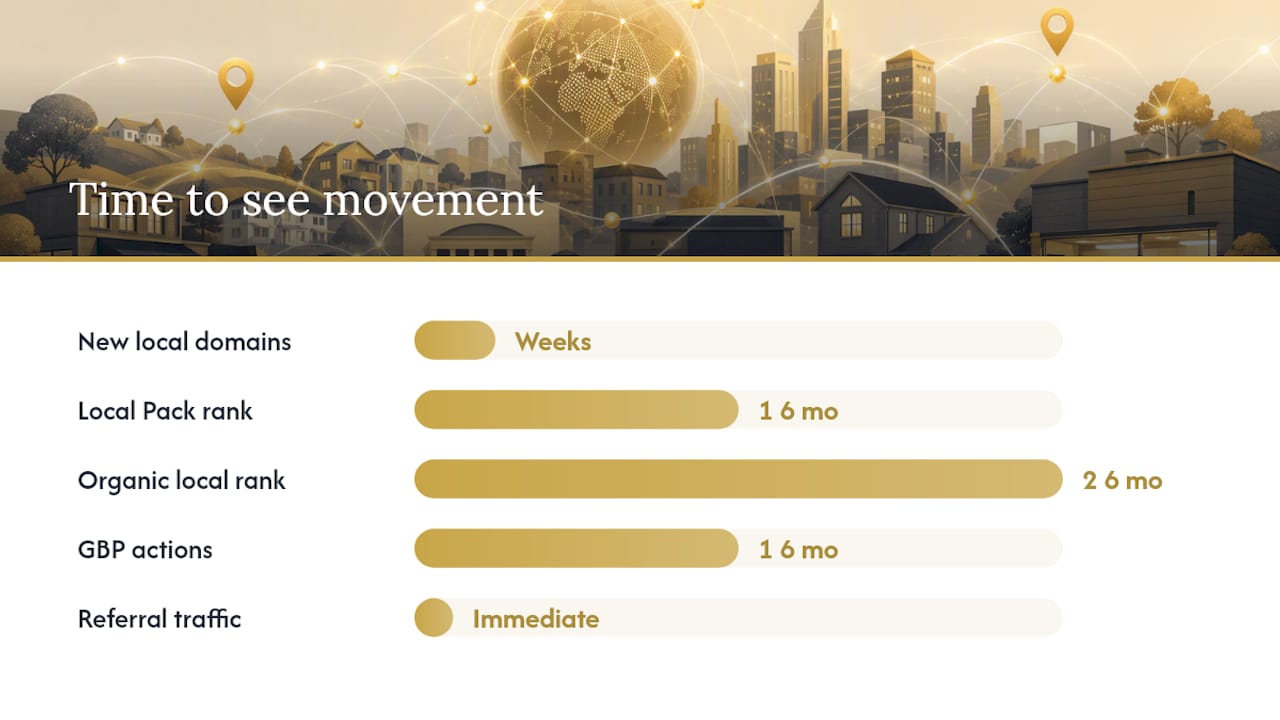
Track a small set of metrics rather than drowning in vanity numbers. Referring domains from local sources, Google Business Profile actions (calls, direction requests, website clicks), local organic ranking positions for your priority terms, and direct referral traffic from the links themselves all tell you something the others don’t.
| Metric | What it tells you | Typical timeline to see movement |
|---|---|---|
| New local referring domains | Raw link acquisition pace | Weeks, as links go live |
| Local Pack ranking position | Whether links are affecting map visibility | 1 to 3 months |
| Organic ranking for local terms | Broader authority gains | 2 to 6 months |
| GBP actions (calls, directions) | Whether visibility is converting to enquiries | 1 to 3 months, alongside ranking shifts |
| Referral traffic from new links | Direct value beyond SEO | Immediate, once the link is live |
Local link building combined with a clean citation foundation is the combination that most reliably moves businesses into the Local Pack, and that effect tends to compound over several months rather than appearing overnight. Link signals remain a meaningful part of local organic and map pack ranking, even though the exact weighting shifts and nobody outside Google knows the precise formula.
To attribute links to actual enquiries, tag key sponsor and partner links with UTM parameters where the host site allows it, and check Google Search Console for new query impressions tied to your priority local terms in the weeks after a link goes live. A simple dashboard combining Search Console, Google Business Profile insights and a manual backlink tracking sheet covers most of what a small business needs without paying for enterprise software.
Dos and don’ts: vetting local link opportunities properly
Avoid automated directory submission packs and mass-listing services that promise “500 local citations for £50.” These typically dump your business into low-quality, unmoderated directories that Google either ignores or, worse, associates with spam patterns.
Before accepting or paying for any link, run through this checklist:
- Does the site publish genuine editorial content, or is it just a shell built to sell links?
- Does the site have any real local relevance, or is “local” just a keyword stuffed into its name?
- Can you find evidence of real traffic or engagement (social shares, comments, an active publishing schedule)?
- Has the site been live and consistent for more than a year, or does it look freshly spun up?
- Would a real customer plausibly find and trust this page?
Don’t dismiss NoFollow links as worthless. A healthy local link profile contains both NoFollow and Dofollow links, and NoFollow links still send referral traffic and act as hints for search engines discovering new content, even without passing full link equity. A NoFollow mention on your town’s most-read community Facebook group page is still worth having.
How Blindspot approaches local link building for Sussex businesses
Blindspot has run local SEO and link building for service businesses across more than ten industries, including security companies, builders, HVAC installers and dentists working throughout Sussex. That range matters because local link building looks different for a locksmith than it does for a dental practice, and generic tactics rarely translate cleanly between the two.
The process Blindspot runs typically follows four stages: an audit of existing links and citations to spot gaps and unlinked mentions, targeted outreach to chambers, sponsors and partners identified during that audit, creation of linkable local content (guides, data pieces, case studies) where existing assets fall short, and ongoing measurement against Google Business Profile actions and local ranking movement.
A tracking spreadsheet with columns for prospect name, contact, score, outreach date, follow-up date and outcome is the single most useful template a business can start with today, whether working alone or handing the process to an agency. Combined with a content asset like a local guide or a small original survey, that spreadsheet becomes the backbone of a repeatable local link building programme rather than a one-off scramble.
Budgeting your effort: when to run this yourself and when to hire
Realistically, local link building needs consistent monthly attention rather than a one-off sprint. Ten to fifteen outreach emails a month, alongside one piece of linkable content roughly every quarter, is a sustainable pace for a single-location business run by an owner with other jobs to do.
Once you’re managing multiple locations, competing in a genuinely crowded market, or simply don’t have five spare hours a week, that’s the point to consider an agency. It’s not about lacking the skill to write an email. It’s about consistency: link building rewards businesses that keep asking, month after month, long after the initial motivation fades.
If you do nothing else this week, do this: pull up your Google Business Profile, check your NAP consistency across your top ten citations, and email one supplier or event organiser asking for a link you’re genuinely owed. That single action moves you ahead of most local competitors who never get past thinking about it.
— Harry
Get expert help with local link building and GEO visibility
An agency can provide a connected local link building service that combines outreach, content, and citation audits, avoiding the need to coordinate separate freelance jobs.
A typical local link building engagement starts with an audit of existing links, citations, and unlinked mentions, followed by targeted local outreach, creation of linkable content assets that earn press coverage, and monthly reporting focused on Google Business Profile actions and ranking movement rather than just vanity link counts. The SEO & GEO service covers this end to end, alongside AI search optimisation so your business shows up correctly when tools like ChatGPT and Perplexity answer local recommendation queries. Where a link opportunity needs a proper content asset behind it, a local guide, a data piece, a case study, the content creation and video editing service builds it, and social amplification helps get sponsorships and press mentions in front of the people who decide what gets linked to.
Some agencies offer tiered plans scaled to the level of service you want handled. If you’d rather have a specialist run the audit, outreach and reporting than build the spreadsheet yourself, get in touch with Blindspot to see what a tailored plan looks like for your business.
Sources
- What is local SEO? — SEMrush
- 13 local link building tactics to boost your visibility — BrightLocal
- Essential local link building tactics — Moz
- Local link building: how to dominate your local market — Link Building Journal
FAQ
What does link building mean?
Link building is the practice of getting other websites to link to yours, which signals trust and relevance to search engines. In a local context, that means prioritising links from sites tied to your geographic area over generic high-authority sites elsewhere.
Is local SEO a real, separate discipline from general SEO?
Yes. Local SEO focuses specifically on visibility for geographically bound searches, covering Google Business Profile optimisation, citation consistency and local link building rather than general keyword ranking. It uses many of the same underlying principles as broader SEO but weights geographic relevance far more heavily.
What are the main types of link building?
The main categories are editorial (earned through content or relationships), outreach based (direct requests, guest posts, resource page pitches), and reclamation (recovering unlinked mentions of your business). Local link building overlaps most heavily with the outreach and reclamation categories, since editorial links at scale are harder for small local businesses to earn without a genuine news hook.
What are some free options for local link building?
Chambers of Commerce membership, local directory listings, sponsorship of community events, and reclaiming existing unlinked mentions all cost time rather than money. Google Alerts and Google Search Console are free tools for finding mentions and tracking referral traffic from links you’ve already secured.
How much does Blindspot charge for local link building support?
Blindspot doesn’t publish fixed prices for its SEO and GEO service, since local link building work is scoped to each business’s industry, competition and location. Current pricing details are available directly through the Blindspot services page.