6 to 12 Months to ROI? SEO Timeline and Blindspot Benchmarks to Check

Most sites see early signals (indexation, impressions, small ranking movements) within 6 to 12 weeks, measurable traffic and ranking gains by 3 to 6 months, and meaningful ROI, meaning enquiries or revenue you can attribute to organic search, between 6 and 12 months. The exact pace depends on your domain’s age, how competitive your market is, how many technical issues you’re starting with, and how many hours go into the work each month.
TL;DR:
- Most sites see early signals within 6 to 12 weeks, with measurable traffic and ranking improvements typically occurring between 3 to 6 months.
- Technical fixes and foundational work in the first month can restore visibility quickly, but content and outreach efforts take several months to impact rankings significantly.
- New domains and highly competitive markets can add three to six months to the standard timeline, especially for larger ecommerce or multi-location sites.
- Tracking impressions, indexation, and position distribution in Search Console provides early signs of progress well before traffic or revenue increases.
- Patience is essential, as rankings and authority build gradually, and premature program cancellation often occurs just before substantial results emerge.
Table of Contents
- How long does SEO take: the at-a-glance timeline
- Month-by-month: what a realistic SEO timeline actually looks like
- What makes SEO faster or slower for your business
- What should you watch in Search Console while you wait?
- How to speed up SEO without cutting corners
- When should you reassess your SEO provider?
- How Blindspot phases SEO work in practice
- Why patience is the hardest part of SEO to sell internally
- Get a timeline built around your own site, not an industry average
- Sources
- FAQ
How long does SEO take: the at-a-glance timeline
That headline range breaks down into four distinct phases, each with its own expectations and its own definition of “working”. Search Engine Land’s guide on how long SEO takes to work puts it plainly: 3 to 6 months for measurable results, 6 to 12+ months for significant impact, and it’s worth treating both as ranges rather than deadlines.
Here’s what typically happens at each stage:
- Weeks 2 to 12: Search engines index your fixed pages, crawl errors clear, and you see small technical wins like recovered visibility from removed noindex tags or repaired redirects. No meaningful traffic yet, but the plumbing starts working.
- 3 to 6 months: Long-tail keywords start moving, impressions climb in Google Search Console, and some priority terms enter the top 50. This is where you first see proof the strategy is sound, even if traffic still feels modest.
- 6 to 12 months: Traffic increases become reliable rather than sporadic. For most local service businesses, this is when the first enquiries genuinely attributable to organic search start landing in the inbox.
- 12+ months: Head terms and higher-authority pages begin to rank, and returns compound. A page that took six months to reach position 15 might climb to position 4 in month 14, purely because accumulated authority and content depth keep working in the background.
Ahrefs’ analysis of SEO timelines found that most pages which eventually reach top positions get there within 2 to 6 months, but only once the site already has a reasonable authority base. A brand-new domain with no backlink history is starting several steps back, which is why the same tactics can produce very different timelines for two businesses in the same industry.
The mistake most business owners make is expecting a straight line from zero to revenue. It’s rarely linear. Expect plateaus, small dips when Google rolls out a core update, and then a sudden acceleration once enough pages and links have accumulated. That non-linearity is normal, not a sign something’s broken.
Month-by-month: what a realistic SEO timeline actually looks like
Ask an agency for a “guarantee” and you should hear alarm bells, but ask for a realistic sequence of deliverables and you’re entitled to a clear answer. Here’s what a properly run SEO programme typically looks like, month by month.
-
Month 0 to 1: Audit and foundation work. This is where the technical and analytics groundwork happens. Search Console and analytics get connected properly, a full site audit identifies crawl errors, duplicate content, broken redirects, and indexation problems, and the highest-priority fixes go live immediately. Fixing a noindex tag left on a key page or repairing a broken redirect chain can restore lost visibility within days, because Google recommends focusing on genuinely helpful, people-first content and a clean technical base is what lets that content get seen in the first place.
-
Month 2 to 3: Content publishing and on-page optimisation begins. New pages targeting priority keywords start going live, existing pages get rewritten titles and meta descriptions, and internal linking gets tidied up. You’ll typically see the first stirrings of impressions in Search Console during this window, though clicks usually lag a few weeks behind impressions.
-
Month 4 to 6: Outreach ramps up and long-tail pages gain traction. Link outreach that started in month 2 or 3 starts converting into placements, and because technical fixes show effects in days to weeks while content typically takes 6 to 12 weeks to gain traction, this is usually the point where the content published in month 2 finally starts ranking. Long-tail, lower-competition terms move first. For local service businesses, this is also frequently when the first genuine enquiry arrives that can be traced back to an organic search result rather than a referral or paid ad.
-
Month 6 to 9: Priority terms stabilise and conversion tracking sharpens. The keywords you actually care about, the ones with real commercial intent, start settling into more consistent positions rather than bouncing around. This is a good point to tighten up conversion tracking and run basic CRO improvements on your top landing pages, because you now have enough traffic data to know which pages convert and which don’t.
-
Month 9 to 12+: Compounding and year-one review. By this stage, older content is accumulating authority, internal links are reinforcing each other, and new pages tend to rank faster than they did in month one because the domain itself carries more weight. This is the natural point to sit down and properly assess year-one ROI: what traffic converted to enquiries, what the cost per enquiry looked like compared to other channels, and where to scale spend for year two.
Two adjustments matter here. New domains, meaning sites registered within the last year or two with little to no backlink history, typically add three to six months onto every phase of this timeline, according to Ahrefs’ research on SEO timelines for new domains. And enterprise or ecommerce sites usually move slower still, simply because of the scale involved: hundreds or thousands of product pages need auditing, and internal approval processes for content and technical changes add friction that a single-site local business never encounters.
Pro Tip: Don’t wait until month 6 to check whether outreach is working. Ask your agency or in-house team for a list of live link placements by the end of month 3. If that list is empty, the ranking effects due in months 4 to 9 simply won’t materialise on schedule, because link-derived authority typically takes 4 to 9 months to show up in rankings after the link goes live.
What makes SEO faster or slower for your business
Two businesses can run near-identical SEO strategies and land in completely different places twelve months later. The gap almost always comes down to a handful of variables, and knowing where you stand on each one lets you set expectations that actually match reality.
- Domain age and existing backlink profile. A domain that’s been live for five years with a modest but genuine backlink history has a head start no strategy can fully replicate quickly. New content on an established domain often ranks in weeks rather than months, because Google already trusts the site.
- Keyword competition and intent. Ranking for “emergency locksmith Chichester” is a fundamentally different task to ranking for “best locksmith UK”, and both are different again from a national ecommerce head term with millions in competitor ad spend behind it. One insight worth remembering: the single biggest variable affecting how fast you see movement isn’t your budget, it’s how competitive your specific market is. The same strategy can take six weeks in a small local niche and years for a global head term.
- Technical health. Slow page speed, poor mobile rendering, JavaScript that search engines struggle to crawl properly, these issues don’t just cap your ceiling, they delay everything else. Content can’t rank if it isn’t being indexed cleanly in the first place.
- Resourcing and implementation speed. A strategy that calls for four blog posts a month but only gets one published, sporadically, isn’t running behind schedule, it’s running a different, slower strategy. Hours dedicated per month and how quickly agreed changes actually get implemented is one of the most controllable variables in the entire process.
- Content quality and depth. A single 2,000-word guide that genuinely answers a searcher’s question in full tends to outperform five thin 400-word pages targeting the same topic. Depth compounds; thinness doesn’t.
- Off-page work and outreach timing. Outreach started early runs in parallel with content development, so link-derived authority is maturing by the time your content is ready to rank. Outreach started late means waiting for both processes to complete in sequence rather than together.
Score your own business honestly against these six factors and you’ll have a far better sense of whether a 6 month or a 12 month timeline is the realistic one for your situation.
What should you watch in Search Console while you wait?
Impressions move before clicks, and clicks move before revenue. That sequence is the single most useful thing to understand about tracking SEO progress, because it means you don’t have to wait for a sales call to know whether the work is on track.
Google Search Console gives you four signals worth checking monthly:
- Impressions. A rising impressions count means Google is starting to show your pages for more searches, even if nobody’s clicking yet. This is genuinely the earliest reliable signal available, and monitoring impressions and indexation changes gives a faster verdict on whether the technical baseline is working than waiting for click data to accumulate.
- Average position and its distribution. Don’t just look at the average, look at how many keywords sit in positions 11 to 20 versus 4 to 10. A growing cluster just outside page one is a strong sign that a small push, more internal links, a content refresh, could tip several terms onto page one at once.
- Coverage and indexation reports. These confirm your pages are actually visible to Google in the first place. A spike in “crawled, not indexed” pages is worth investigating immediately rather than waiting for a monthly report.
- Click-through rate after title and meta changes. If you’ve rewritten titles or meta descriptions, a CTR shift within two to four weeks tells you those changes are landing with searchers, independent of any ranking movement.
For local service businesses specifically, Google Business Profile views, direction requests, and call clicks often move faster than national rankings, sometimes within 2 to 3 months if the fundamentals are correct, because local pack visibility responds to a narrower, more controllable set of signals than broad organic rankings.
One escalation point worth flagging clearly: if impressions haven’t moved at all by month three, that’s not just slow progress, it’s usually a sign of a crawl, indexation, or targeting problem rather than something that will simply resolve with more patience.
How to speed up SEO without cutting corners
You can legitimately compress an SEO timeline, but only by front-loading the right work, not by finding shortcuts that skip steps Google actually checks for.
Here’s the priority order that gets results fastest:
- Priority 1: Fix crawlability and critical technical issues in weeks 1 to 4. Broken redirects, incorrect noindex tags, and poor mobile rendering are the fastest wins available, often visible within days to weeks of the fix going live.
- Priority 2: Publish targeted, intent-mapped content at scale, not sporadically. A consistent publishing schedule against genuine search intent typically takes 6 to 12 weeks to start showing ranking movement, according to research on SEO action lag times.
- Priority 3: Start link outreach in month 2 or 3, not month 6. Because link-derived ranking effects typically take 4 to 9 months to fully materialise, starting outreach early means those gains arrive in parallel with your content gains rather than stacked on top afterwards.
The single most effective way to compress a timeline legitimately is front-loading both technical fixes and outreach simultaneously rather than treating them as sequential phases. Deferring outreach until content is “ready” routinely adds several months onto the total timeline for no real quality benefit.
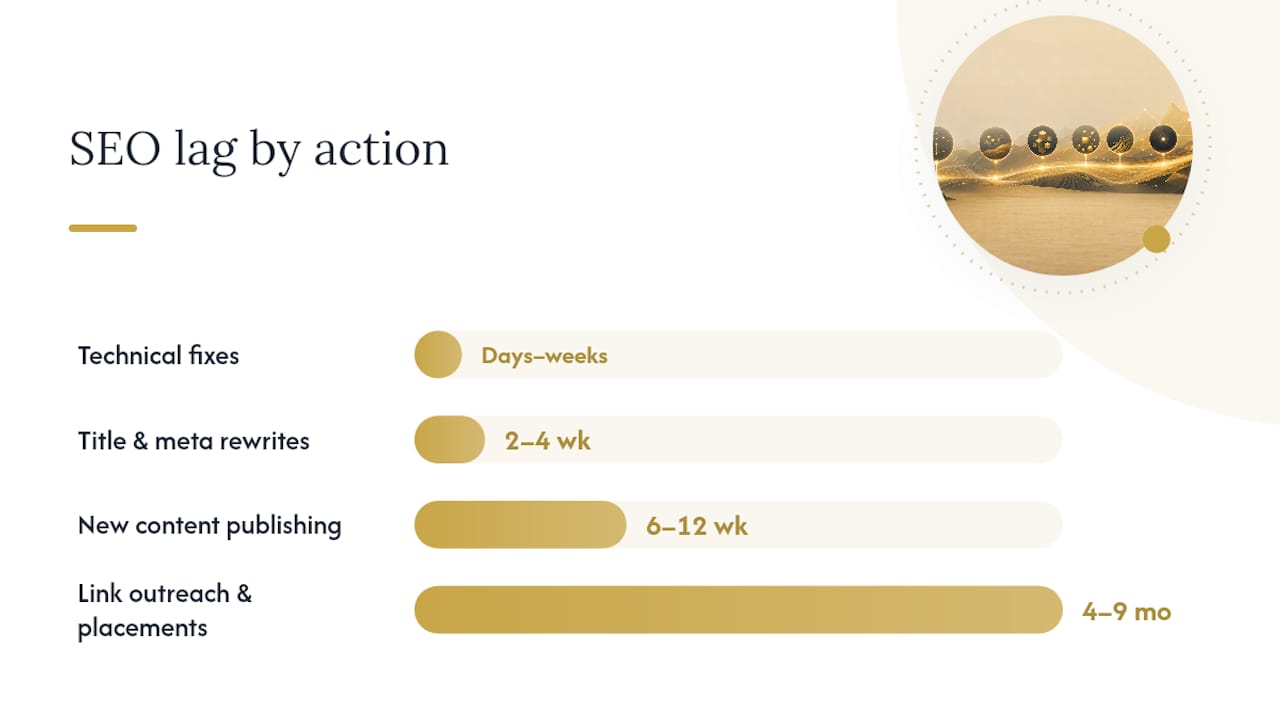
| Action | Typical lag before impact | What it buys you |
|---|---|---|
| Technical fixes (redirects, noindex, crawl errors) | Days to weeks | Restored visibility for pages already built |
| Title and meta rewrites | 2 to 4 weeks | Improved click-through rate on existing rankings |
| New content publishing | 6 to 12 weeks | New keyword visibility and long-tail traffic |
| Link outreach and placements | 4 to 9 months | Increased domain authority and improved rankings for competitive terms |
On budget, practical guidance on SEO resourcing suggests there’s a minimum effective hours band below which work simply doesn’t compound properly. A single blog post published every two months with no outreach and no technical maintenance isn’t a slower version of an effective strategy. It’s a different, much weaker one.
Pro Tip: AI tools can genuinely speed up content drafting, and that’s worth using. But AI speeds up production, not the ranking clock itself. A page written in ten minutes by an AI tool still has to be crawled, evaluated, and earn trust over the same weeks and months as a page written by hand. Faster drafting is not the same as faster ranking.
Avoid shortcuts that promise otherwise: bulk-bought links from unrelated sites, AI-generated content published without editing or fact-checking, and any agency offering “guaranteed page one in 30 days” almost always mixes in paid tactics or is setting you up for a penalty down the line, a point Search Engine Land’s SEO timeline guide makes explicitly.
When should you reassess your SEO provider?
Two checkpoints matter more than any others: month three and month six.
- At month three, you should see impressions rising in Search Console, a clear audit report with fixes already implemented, and a documented content and outreach plan for the next quarter. If impressions are flat and there’s no evidence of technical fixes going live, that’s a legitimate reason to ask hard questions.
- At month six, expect visible ranking movement on at least some long-tail terms, a small number of link placements you can actually check yourself, and, for local businesses, some early sign of Google Business Profile improvement. Ask for a short, independent technical audit if you’re unsure, most reputable SEO consultants will run one for a modest fee, and compare its findings against what your current provider has actually delivered.
Red flags worth acting on immediately, regardless of timeline: no monthly reporting at all, vague answers when you ask for specific ranking or traffic data, promises of instant page-one results, and link building described only as “we have a network” with no named sites or placements you can verify yourself.
How Blindspot phases SEO work in practice
Every SEO programme typically follows a broad sequence: audit, technical fixes, content and on-page work, outreach, then scale, adjusted for the client’s starting point and market. A local trades business with a five-year-old domain and decent existing content moves through that sequence faster than a business starting from a brand new site with thin content and no backlink history.
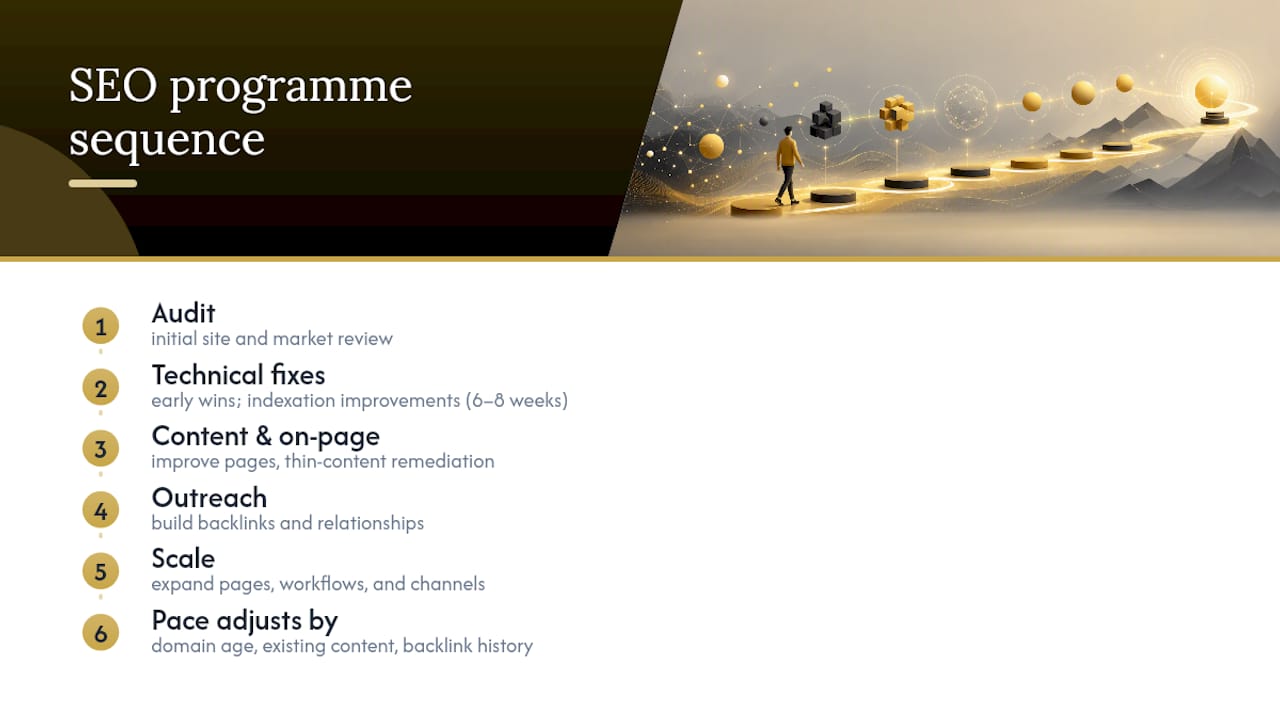
For local service clients, security companies, HVAC firms, builders, and similar trades that depend on enquiries from a defined geographic area, the benchmarks tend to track close to the ranges covered above: early technical wins and indexation improvements in the first six to eight weeks, Google Business Profile and local pack movement within two to three months, and organic enquiries becoming a reliable, trackable channel somewhere between month six and nine. Ecommerce and larger, multi-location projects generally take longer, simply because there’s more to audit, more pages competing for the same crawl budget, and more stakeholders involved in approving changes.
Clients typically receive monthly reporting that tracks leading indicators covered earlier in this article: Search Console impressions and position data, indexation status, content and outreach delivered against plan, and, once enough data exists, enquiry attribution. The point of that reporting isn’t just to show activity, it’s to give a client enough visibility to judge progress for themselves rather than take an agency’s word for it.
Why patience is the hardest part of SEO to sell internally
Cancelling an SEO programme at month four because “nothing’s happening” is one of the most expensive mistakes a business can make, not because the work was wasted, but because most of the value it was building was about to arrive. Rankings and authority compound. Stopping just before that compounding kicks in means losing the return on months of groundwork that a competitor, or a future re-engagement, ends up capturing instead.
The fix isn’t blind faith, it’s internal alignment before the work starts. Agree a reporting cadence with whoever signs off the budget, walk them through what impressions and indexation actually mean before month one even begins, and set the month three and month six checkpoints as genuine review points rather than arbitrary dates. When stakeholders know what “on track” looks like in Search Console terms, a quiet month two stops feeling like failure and starts looking like exactly what it is: the audit and fixes phase doing its job.
Keep watching the indicators covered earlier, impressions, indexation, position distribution, and you’ll rarely need to guess whether a programme is working.
— Harry
Get a timeline built around your own site, not an industry average
Every range in this article is a starting point, not a prediction for your business specifically. A practical alternative to guessing is to start every engagement with a full technical and competitive audit of your actual site, so the phasing you get, weeks one to four, months two to six, and beyond, reflects your domain’s real age, your market’s real competition level, and the technical issues actually sitting on your pages today.
That means no vague promises about “ranking soon”. You get a specific, defensible sequence of deliverables tied to the indicators covered above, impressions, indexation, position movement, built from what our SEO & GEO service actually finds when it looks under the bonnet of your site. Alongside SEO work, our social media marketing support helps distribute content faster, which shortens the discovery lag new pages typically face.
If you’re a local business in Sussex weighing up whether your current results match a realistic timeline, or you’re about to start from scratch, get in touch through Blindspot’s main site and ask for a review of where your site currently stands. You’ll get a straight answer, not a sales pitch.
Sources
- How long does SEO take to work? SEO timeline & results explained
- How Long Does SEO Take to Show Results?
- Creating helpful, reliable, people-first content — Google Search Central
FAQ
How long does SEO take to show results?
Early signals like indexation and rising impressions typically appear within 6 to 12 weeks, measurable ranking and traffic gains arrive around 3 to 6 months, and meaningful ROI usually takes 6 to 12 months or longer depending on competition.
Is SEO very difficult?
SEO isn’t conceptually difficult, but it demands consistency across technical health, content quality, and outreach over months rather than weeks, which is where most businesses underestimate the commitment involved.
Is SEO dead now with AI?
No. AI tools speed up tasks like content drafting, but they don’t shortcut the crawling, trust-building, and evaluation period Google applies to new or improved pages, so the underlying SEO timeline hasn’t fundamentally changed.
How long does SEO take to learn?
Understanding core SEO concepts, technical basics, on-page optimisation, and link building, can take a few months of consistent study, but developing genuine judgement about strategy and prioritisation typically takes hands-on experience across multiple sites and industries.